Europe
Top 20 UK SMID stocks
Their Systematic Analysis Model (SAM) ranks 290 UK stocks by combining revisions momentum, shareholder value and valuation to identify the most attractive opportunities. Hikma Pharmaceuticals and SigmaRoc are the latest additions to their top 20 ideas. HIK screens as unusually cheap for its quality, ranking in the top quintile on capital-returns valuation and trading at just under 8.5x FY2 P/E. ROCE has been improving since 2022, revisions momentum has strengthened for 8 months and is back above median, while a new CFO and strategic reset provide meaningful recovery potential. SRC has seen ROCE grind higher with OPAT margins increasing materially following the successful integration of CRH assets. It is still very cheap with the market implying it can only do 6% ROCE with the FY2 forecast at 8%. Revisions Momentum is back above median and improved significantly over the past 3 months. There is also scope for further M&A. TPs are 1900p for HIK and 216p for SRC.
Consumer Staples
Q2 was another strong quarter, with sales up 19% Y/Y and earnings up 85%. Management cut FY EBIT guidance by 4% on higher input costs and outlined €127m of gross capex to double production capacity by 2028 and triple it by 2030. The key point, however, is that capacity - not demand - is increasingly the constraint on growth. ResearchGreece upgrades the stock to OWN IT and raises their target price to €41.3 from €25.1, arguing their previous DCF horizon to 2030 failed to capture the company’s higher-for-longer sales growth potential. They extend the DCF to 2035, assuming 2026-35 sales, EBITDA and net income CAGRs of 13-14% and FCF conversion of 65-68%, with their 10% WACC and 3% terminal growth rate unchanged.
Industrials
Willis Welby sees the clearest upside in MRO and BA, while remaining more cautious on RR despite strong fundamentals. MRO looks particularly mispriced, with its implied-to-Y3 EBITM ratio of just 28; Willis Welby believes the market is moving on from Garden Grove and sees either a refinancing or takeover as a potential catalyst, with 100%+ upside. BA has pulled back enough to become attractive again, with its ratio falling to 85 despite still-supportive defence spending. RR remains a high-quality business with strong aerospace franchises and growing SMR momentum, but at a ratio of 132 Willis Welby would not chase the shares.
Materials
BASF’s reported €22.15 approach for EVK has been rejected as too low, but European Research believes €24-27 is achievable without stretching the valuation, with €25 their base case. At that level, BASF would pay 7.17x FY26E EBITDA, falling to 6.06x after €400m of estimated synergies, while RAG-Stiftung’s 43.8% stake would be worth €5.10bn. A partial RAG rollover into BASF could help bridge the gap while limiting the balance-sheet impact. They assign a 70% probability to a transaction, giving a probability-weighted value of €22.97, rounded to a €23 target price. That implies 15.8% upside from €19.84 vs. 8.9% downside to the €18.07 unaffected price.
North America
Family transactions and bad revenue recognition
Hudson Labs uses proprietary AI-driven research and forensic risk screens to analyse public-company filings, transcripts and disclosures for accounting, governance and litigation red flags. Trimble stands out in their latest round-up after EY issued an adverse opinion over “the evaluation of performance obligations utilized in the accounting for revenue”; the company subsequently fired EY, replacing them with KPMG last year, while controls over revenue and related accounts were still not fully fixed as of August. The audit committee chair has also recently resigned and segment reporting has changed 3 times in 3 years. Tandem Diabetes was flagged separately for governance and operational issues, including a personal relationship between the CEO and CFO, a director’s family relationship with an employee, the abrupt dismissal of the COO, and rising receivables as a percentage of sales.
Communications
Andrew Freedman moves RBLX from short to long, arguing the stock trades on the rate of change in bookings growth and that 3Q26 should mark the low point in the slowdown he had anticipated for this year. Bookings growth has fallen from 70% in 3Q25 to 8% in 2Q26, with 3Q26 guided to a 14-18% decline, but comparisons ease materially from here into 2027. Engagement is also improving, with mobile DAUs turning positive Y/Y in Sep and concurrent-user declines narrowing, while Steal an Egg may be the start of a new content cycle. RDC distribution changes should broaden discovery, although GTA VI creates a Q4 risk. With 2027 estimates reset, Andrew sees ~40% upside over the next 9-12 months.
Energy
Priced for shrinking margins just as pressure-pumping capacity is tightening. North American frack calendars are already filling, pricing power is improving and record-low inventories of drilled-but-uncompleted wells mean producers increasingly need new drilling rather than simply completing old wells. International growth provides a second leg, with HAL targeting ~$16bn of revenue by 2028. Recent awards in Brazil and Saudi Arabia add further upside, while Kailash sees potentially substantial future revenue and profits from Venezuela, where HAL could be one of the biggest “picks and shovels” beneficiaries if the recently announced US oil deal progresses. FCF remains strong and has funded meaningful buybacks. Despite this improving backdrop, the stock trades at just 15.3x 2026E P/E and 8.5x EV/EBITDA, large discounts to SLB, Baker Hughes and the broader market.
Financials / Business Services Idea Forum
Financials
While rate-sensitive names were well represented at MYST’s latest buyside event, they were struck by the large number of thematic ideas discussed. A handful were idiosyncratic / event-driven and, as has become the norm, most pitches carried an “AI winner or loser” angle. ACI Worldwide was the most popular idea pitched, with the biller sale seen as creating a “sexy” payments-infrastructure takeout target, while CoStar was considered the most contrarian, with Homes.com spending cuts expected to fuel an “EBITDA revision story” under the new CFO. Other ideas included Affirm, viewed as an underappreciated agentic-AI winner with rate fears already in guidance; Alexandria Real Estate Equities, where a biotech funding surge could drive lab-leasing inflection; and Brink’s, where NATL synergies and a shift towards higher-growth ATM services are seen as overlooked by the market.
Ageing well & growing strong
Healthcare
An ageing US population provides a powerful structural tailwind for this healthcare-services company, with demand also supported by rising behavioural-health needs. New Constructs’ thesis is backed by a long record of execution: revenue and NOPAT have compounded at 8% and 11% annually since 2006, while Core Earnings have grown 12% compounded annually. The company improved its NOPAT margin from 5% to 9% in the TTM even as invested capital turns fell from 1.5 to 1.3. Rising NOPAT margins offset invested capital turns, driving ROIC from 8% in 2006 to 12% in the TTM. More recently, revenue and NOPAT have still compounded at 8% and 9% since 2021. With admissions and revenue per admission rising, strong FCF and shareholder returns, New Constructs sees a rare combination of durable demographic tailwinds, improving economics and a cheap valuation.
Healthcare
Foveal has published a new PCVX / VAX-31 note ahead of the OPUS-1 adult pneumococcal vaccine readout expected later this month. They have gone serotype by serotype across the key comparisons with Merck’s PCV21 and Pfizer’s PCV20, assessing where VAX-31 is most likely to beat or miss management guidance, how material those deviations could be, and the adult IPD burden associated with each serotype. They identified a few areas where they think the likely read-through is not fully reflected in the current market framing, without this being a simple binary upside / downside event.
Industrials
Investors are focusing too heavily on headline organic growth and not enough on the profitability and returns behind it. Reported underlying organic growth of c.3-4% has trailed peers, but Veritas estimates intentional post-acquisition shedding of lower-margin business has created a ~100bp volume headwind; adjusted for that, underlying volumes are only modestly negative and broadly in line with peers. That discipline has supported industry-leading ~33% margins, ~60bps of annual margin expansion since 2024 and attractive ~13% incremental ROIC. Veritas also sees Chiquita Canyon remediation costs declining and notes WCN remains ~6.5x cheaper than GFL on sustaining FCF. With the shares at their lowest premium to Waste Management / Republic Services in a decade, Veritas maintains a Buy rating and a valuation of US$198.
Materials
The share price has completely diverged from the underlying physical fundamentals, just as the petroleum-additives market is becoming increasingly oversupplied. Chinese competition is ramping, with producers moving from selling only components into full additive packages, while Afton Chemical’s own shipping data points to persistent weakness: volumes have fallen mid- to high-single digits for six consecutive quarters. Chinese exports have risen more than 20% annually in each of the past two years, with further capacity still being added. Iran-related surcharges are currently masking that deterioration by supporting pricing and profits, but some of those gains could reverse if customers push back on the higher prices or if the underlying surcharge-related costs fail to materialise, potentially forcing rebates. 2026 is likely to be peak earnings. TP $620 (30% downside).
Technology
Hamed Khorsand argues the proliferation of AI agents will sharply increase the need for guardrails, making development, testing and evaluation a more recurring source of revenue for INOD. The company is already generating revenue from AI-agent work, while Meta (INOD’s largest customer) is a key catalyst following the commercial launch of Muse. A second large customer and potential US federal-government work provide further diversification. Hamed expects revenue growth to exceed the company’s 40% target by Q4 and still forecasts ~37% growth in 2027. INOD is his Top Pick with a 12-month TP of $140 (110% upside).
Technology
BTN questions how much of MXL’s recent improvement in sales and adjusted earnings can be sustained, particularly at ~50x adjusted EPS. Sales allowances have fallen from ~100 days of sales to just 25, including substantial reversals of prior accruals, materially supporting both reported revenue and pretax income. At the same time, equity-based compensation exceeds adjusted EPS and cash flow, while increased stock compensation may have added as much as 6.4c to Q2 non-GAAP EPS. Fully depreciated equipment provides a further estimated 5.2c benefit, while BTN estimates the unusually low 3% non-GAAP tax rate added another 2.6c - enough that MXL would otherwise have missed consensus. Meanwhile, sharply higher inventory purchase commitments point to a working-capital rebuild that could put further pressure on cash flow.
Asia
Communications
Although WorkBuddy is not yet an earnings asset, it is where evidence that Tencent’s AI can earn a return is most likely to emerge first. The enterprise AI-agent market is real, with a RMB257bn addressable opportunity and a low ROI hurdle: ~8 minutes of daily employee time saved pays for a seat, while ecosystem platforms can also pull through model, cloud and workflow revenue beyond seat fees. WorkBuddy leads on execution, but competition should intensify in Q4 as Alibaba, ByteDance and Baidu consolidate around single flagship agents, making workflow lock-in increasingly important. Longer term, 86Research expects an oligopoly led by Tencent and Alibaba, with ByteDance a strong third. Paid seats already earn ~35-40% gross margins, while free usage remains the key breakeven drag. More broadly, success would strengthen the investment case for Tencent’s wider Hunyuan, Cloud and WeCom ecosystem. TP HK$784 (80% upside).
NSE IPO: It’s not running away
Financials
At its IPO price of ₹1,785, NSE was valued at ₹4.42tn (US$46bn), equivalent to 40.8x Sree Capital’s FY27E earnings estimate. Despite its dominant market position, selling pressure remains even after listing. Derivatives regulation, CAS, RBI funding restrictions, competition from BSE / MSE and the potential NCL structural issue remain key overhangs. Future share-price performance will depend heavily on how the regulatory landscape for derivatives evolves.
Global sub-$200 smartphone segment faces sharp decline
Technology
While Counterpoint expects the smartphone market to recover towards 2025 unit volumes by 2030, they see a radically different mix: more than 230m annual sub-$200 shipments are forecast to disappear, leaving the affordable segment ~40% smaller. Higher memory and chipset costs, rising minimum specifications and tighter OEM economics are making the lowest-priced devices increasingly difficult to support. Crucially, the lost volume is not expected to migrate fully into the mid-range, implying longer replacement cycles, greater used / refurbished substitution and slower first-time smartphone adoption in lower-income markets. The result should be a structurally higher-value market, favouring vendors with broad portfolios and credible premium franchises, while entry-tier specialists face greater pressure.
Developed Markets
EPS drives equities as markets derate
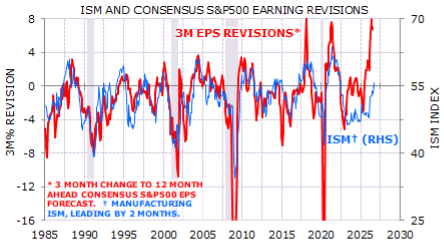
Gerard Minack reviews the continually rising forecasts of corporate earnings forecasts, which are supporting global equity markets that are now derating. Markets started to derate because the AI earnings boom is unlikely to be sustained. It is also typical for equities to derate in tightening cycles. The derating in the AI boom is a contrast to the valuation-driven TMT cycle. US equities have underperformed since early 2025, despite America’s AI leadership. The fact is, AI doesn’t make money, selling to AI companies does. Meanwhile the sell side keeps revising up its earnings forecasts. The US upgrades over the past 3 months have only been matched in the post-Covid rebound and after the Trump corporate tax cut (Exhibit 1). Equities now face a new headwind: monetary policy tightening. All three G3 central banks – the Fed, ECB & BoJ – have hiked this month. Gerard notes it’s typical for equities to derate as central banks tighten. If the AI trade falters, there could be an extended reversal for growth.
AI’s Minsky moment
Paul Krake warns that the market is edging closer to a Minsky moment in the AI infrastructure trade, as the industry builds out capacity around a development timetable its own leaders no longer believe is safe. Dario Amodei calling for a slower pace of frontier-model development directly challenges the thesis underpinning massive capex from Microsoft, Alphabet, Amazon, and Meta. Paul argues that while inference demand will endure, data-centre pipelines, power generation commitments, and Nvidia’s valuation rely heavily on accelerating frontier training requirements. He reckons that international agreements will fail because trust dissolves once AI is viewed through a national-security lens, leaving verification unworkable against China. This uncertainty jeopardises the timing and valuation of Anthropic’s potential USD$2trn IPO. With September seasonally weak for equities, any weakness in AI-linked assets could become self-reinforcing as investors recalibrate growth expectations lower.
An Aschenbrenner moment in rates
James Aitken argues that with US nominal GDP tracking 7.5% plus alongside a colossal global capex boom, current ten-year Treasury yields of 5.19% are not punishing, nor is US monetary policy remotely restrictive. Every crowded position is being hunted down in what James calls an Aschenbrenner moment in rates markets, driven by brutal position unwinds rather than macro fundamentals. While wary of picking a bottom in bonds without fiscal restraint, James highlights that asymmetric convexity and 5.5% long bond yields mean income is finally working for investors. For fully funded inflation-plus accounts, James views the ten-year US TIPS at 2.87% as a buy and a hedge against refining crisis demand destruction. He would also bet against the RBA delivering the three hikes priced by April 2027. Realised inflation plus 2.87% on ten-year TIPS feels all right: he wants to own that.
UK: Burnham dumps the triple lock
Graham Turner highlights that Andy Burnham dumping the triple lock to fund social care signals a prime minister willing to make tough choices, yet surging public sector pay remains the critical market flashpoint. While the gilt market has welcomed the reform, narrowing the 30-year Gilt-US Treasury spread, fiscal pressures are mounting rapidly. Rising global bond yields, FOMC tightening, and accelerating domestic inflation threaten to push annual debt interest well above £100.0bn in 2027, potentially surpassing the prior peak of £111.29bn. Graham warns that higher inflation risks an additional surge in public sector pay, which is already running at more than double private sector earnings growth. Fixing social care is a noble objective: but the real issue for public sector finances, and Gilts, will be whether the new prime minister has the resolve to rein in public sector pay, as inflation climbs.
The BoE leads, the ECB follows?
Marchel Alexandrovich reviews the Bank of England roadmap to retain £120bn of longest-dated gilts permanently to indirectly back banknote issuance, leaving roughly 13% of its original asset purchase facility on the balance sheet. Marchel believes this void filling development offers a clear template for the ECB as it seeks a new normal. While the ECB has released no formal plan, Marchel estimates €600bn to €800bn of European government debt holdings could convert into permanent quantitative easing. With excess liquidity exceeding €2trn circulating through the Eurosystem, Marchel notes the new Vice-President Boris Vujčić favours doubling the minimum reserve requirement to 2%, potentially saving around €4.3bn in annual interest payments. Marchel predicts the ECB will eventually replace maturing bonds by buying government debt in the secondary market, ultimately warehousing around 5% of European government debt by 2031 compared to slightly over 20% currently.
Mélenchon, the under-priced risk
Investors will not dump French sovereign bonds simply because the country is trapped in a debt spiral, but financial markets have not priced in the possibility of a presidential run-off between Marine Le Pen and Jean-Luc Mélenchon. Such a dynamic shifts the focus from rising debt servicing costs to the sustainability of the debt itself. Mélenchon proposes slashing liabilities by converting 488bn euros of paper held by the Banque de France into zero coupon perpetual bonds, a balance-sheet manoeuvre that reduces debt servicing obligations by 17 percent. Although Le Pen rejects these balance-sheet mechanisms, pledging instead 125bn euros in budgetary savings alongside fiscal discipline, the numbers fail to add up. Le Pen’s promised savings look like an unsubstantiated ploy to calm financial markets ahead of the vote, signalling that an extreme second-round contest leaves investors completely exposed.
Will falling unemployment keep US inflation above target?
According to Felix Vezina-Poirier, a tighter labour market over the coming year could cause US inflation to stay elevated even if tariff and energy shocks dissipate. The US labour force has contracted over the past year, driven by the departure of unauthorised immigrants and a decline in the labour force participation rate. This has lowered the threshold for job growth to reduce the unemployment rate. Felix says that a sub-4% unemployment rate may prove to be more inflationary than in some periods in the past. In the late-1990s, productivity gains worked to prevent high inflation when the labour market was tight. AI has the potential to do the same today, but the impact of AI is not yet visible in the productivity data. In addition, inflation expectations are currently elevated. While the risk of a true wage-price spiral is overblown, investors cannot rule out a hawkish surprise from the Fed over the next 12 months.
US: Examining the bond selloff
John Ryding expects the 10-year Treasury yield to finish 2026 at 5%, rejecting claims that recent violent selloffs signal unanchored long-term debt markets. Examining the move from 5.00% to 5.16%, he points out that the entire rise reflects higher real yields rather than runaway inflation expectations, with 10-year implied breakevens remaining anchored at around 2¼%. While Chair Warsh attributes rising yields to economic strength, hyperscaler capital competition, and geopolitics, John argues that the corporate sector has actually supplied net savings, leaving heavy government debt issuance and faster productivity growth as the primary culprits lifting the natural policy rate. He forecasts the Federal Reserve will deliver just one more rate hike in December before tightening again in March. With real 30-year yields already at 3¼%, he is sticking with the projection for a 5% yield at the end of this year.
Canada: Distress deepens
Ben Rabidoux warns that although financial markets price in five Bank of Canada rate hikes over the next twelve months, such aggressive monetary tightening seems unlikely given extreme debt vulnerability. Canada remains near the top of the heap globally with total non-financial sector debt relative to GDP sitting 70 percentage points above the US and 80 above the G20 average. The household sector is extraordinarily exposed following an aggressive push into variable and short-term fixed rate lending, ensuring faster monetary policy transmission. Ben highlights that rising rates and escalating trade tensions have hammered consumer confidence, driving national home sales to 23-year lows while homeowner insolvencies hit decade highs. Simultaneously, a severe cyclical overbuild in purpose-built rentals will pressure residential rents well into 2028 just as distressed selling accelerates. In down cycles, your first loss is your best loss.
The silver tsunami in a booming economy
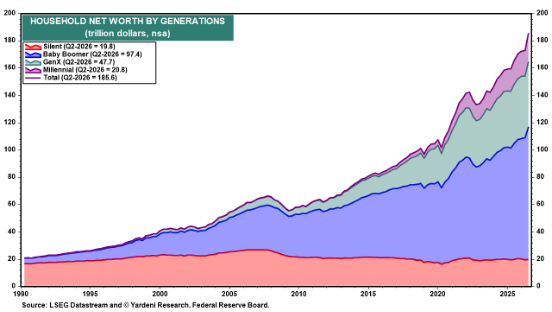
Ed Yardeni has identified a “silver tsunami”, which refers to the large wave of Baby Boomers moving into retirement and the rise in the number of older households. Ed says that demographic shift is increasingly reshaping America’s consumer economy. That helps explain why aggregate spending remains resilient even as younger and lower-income households face more financial pressure. It also fits Ed’s “G-shaped” economy thesis: Consumer strength is increasingly supported by generational wealth, not current income alone. Baby Boomers have accumulated enormous wealth over their working lives and can continue to spend out of those balance sheets in retirement. Indeed, household net worth reached $185.6trn in Q2-2026, with Baby Boomers alone holding $97.4trn (see chart). Ed notes that the latest economic data suggest that the US economy remains on a solid growth path: consumer spending remains strong, hiring is picking up, and manufacturing activity is improving.
Emerging Markets
Asian bonds: Stay A-float
Warut Promboon warns that fixed rate bonds and equities relying on discretionary spending will continue to underperform floating rate bonds as the Federal Reserve hikes into an oil shock. With headline PCE at 3.7% and WTI crude trading back near USD$100/bbl, the question has shifted from when the Fed cuts to how far it hikes, leaving the conflict's risk premium durable rather than transitory. Although Asian credit fundamentals remain resilient, rising risk-free benchmarks will exert upward pressure on regional borrowing costs, keeping yield-to-worst spreads widening rather than compressing. Warut advises investors to deploy a bond laddering strategy to avoid locking capital into prevailing rates while shifting directly into floating rate bonds that reset higher with each subsequent Fed tightening. For fixed rate allocations, hedge exposure using interest rate swaps, or harvest carry via short-duration credits such as State Bank of Mongolia 8.9% 2028 notes.
The EM mirage
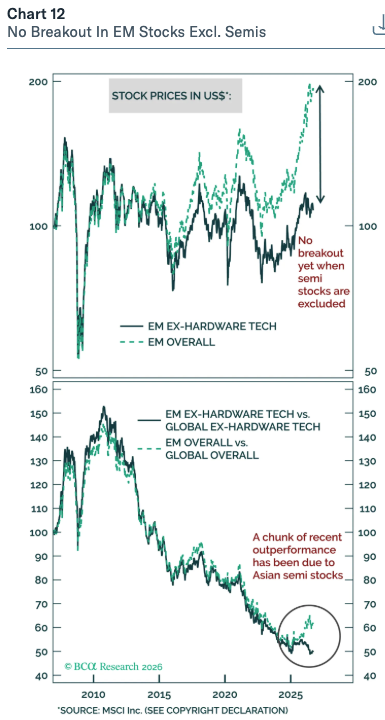
Arthur Budaghyan warns that underlying emerging market equity performance has been dismal, with headline gains driven entirely by three Asian semiconductor stocks comprising 28% of the MSCI EM index. Excluding hardware technology, EM equities have fallen to an all-time low relative to global peers. Arthur expects an impending downleg across the asset class as market breadth deteriorates severely, with just 43% of constituents trading above their 200-day moving average. Rising US Treasury yields are feeding directly into higher borrowing costs for sovereign issuers, pushing up the cost of capital in both USD and local-currency terms. For global equity portfolios, the stance is neutral EM against an underweight in the US. Within EM allocations, maintain relative overweights in China as a defensive play, India on improving capital flows, and Taiwan over Korea, while closing out the long China/short KOSPI tactical pair trade at a 15% loss.
Argentina: An entry point in credit
Economic activity plummeted 2.9% mom and 1.4% yoy in July, an unusual reading driven by one-offs that will revert. Marcos Buscaglia expects activity expanded nearly 1% yoy in August alongside a strong seasonally adjusted recovery, before edging up more slowly in September. Output volatility reached 1.6 times historical levels during 2026, explained statistically by sector swings and net taxes, with tariff adjustments and fiscal policy serving as primary drivers. Marcos cuts his 2026 GDP growth forecast to 2.0% to mark to market July’s plunge, leaving the third quarter likely to signal recession absent upward revisions. Yet the ex-primary economy should stabilise or expand marginally, aided by expansionary monetary policy, low real ex-ante rates, provincial spending, soaring exports, investment spillovers, and ending inventory drawdowns. The recent sell off provides a good entry opportunity in credit as fundamentals remain very strong.
China: Surgical fiscal and monetary tools
According to Niall Ferguson, Beijing’s stimulus toolkit is evolving. As China chases a growth model dependent on advanced technology, strategic capital reallocation has replaced floodgate stimulus. Policymakers certainly hope the new strategy can resolve both the issue of excess liquidity seeking yields and the underfunding of its technology ambitions. In the interim, however, China’s fiscal and financial institutions face the challenge of executing precision after years of perfecting scale. Fiscal and monetary tools are becoming more surgical and increasingly resemble instruments of industrial policy. Meanwhile, third-quarter Chinese growth looks to be bleaker than H1, but Niall doubts Beijing is preparing the sweeping stimulus packages of the past. Instead, he expects policymakers to opt for accelerated bond deployment, reallocation of existing bond quotas, and targeted capital reallocation policies to shore up 2H26 growth.
Trading Chinese assets with pollution data
Jeffrey Young outlines a predictive framework using atmospheric nitrogen oxides (NOX) data to provide actionable trading signals around Chinese purchasing managers’ index (PMI) and industrial production (IP). Given the heavily industrialised nature of China’s economy, power plants and factories are major contributors to atmospheric NOX, offering early insight into economic activity, particularly during Lunar New Year when official data are suspended. DeepMacro’s primary output is directional change rather than point estimates, as delta is most relevant for financial markets. The framework outperforms consensus forecasts in predicting one-month forward directional moves for SHCOMP and CNH. Over a ten-year backtest, Jeffrey correctly predicted SHCOMP direction 63 times versus the median’s 51, and CNH direction 53 times versus 48. Statistically, consistently beating consensus is exceptionally difficult; DeepMacro’s framework does as well or better than knowing the actual data in advance.
China: Moving defensive
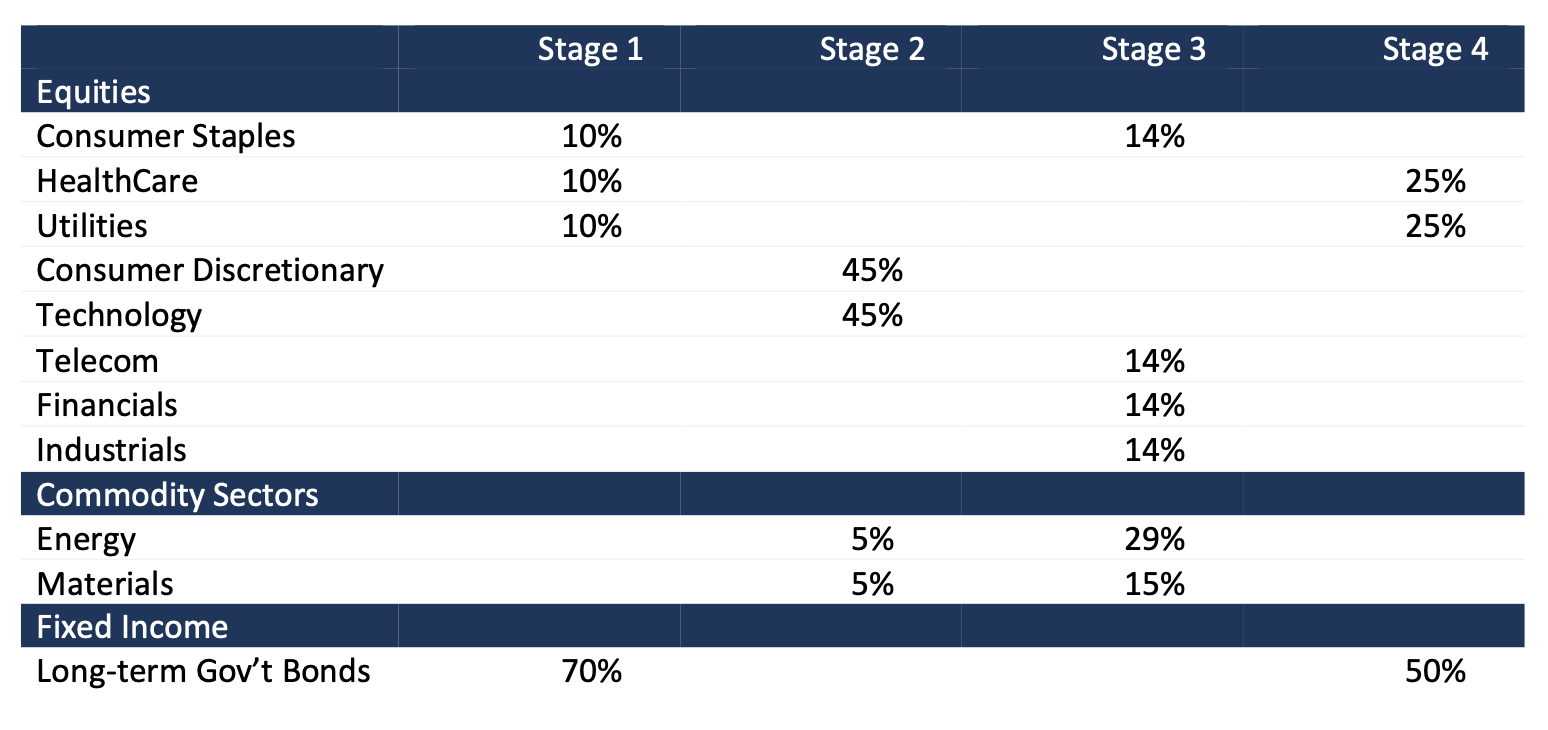
Frank Shostak updates China as rotating into the defensive Stage 4 of the business cycle, where early monetary headwinds emerge. With cyclical momentum turning fragile, Frank expects risk assets to face stiffer hurdles and advocates an explicit pivot towards defensive equity sectors relative to cyclicals. The monetary environment now proves far more beneficial for risk-averse debt, such as government bonds, over corporate credit and high-yield debt. In contrast, domestic liquidity measures are beginning to strengthen, suggesting that equity market momentum may be supported ahead. For August, the Chinese strategy gained 5%, outperforming the SSE Composite Index return of 4%. To manage the downturn, commodity exposures are eliminated entirely, setting allocations to basic materials alongside oil and gas to zero. Tactical portfolio parameters mandate 50% in 10-year government bonds, while remaining equity exposure is divided equally between utilities at 25% and healthcare at 25%.
Korea: Cost-push for now
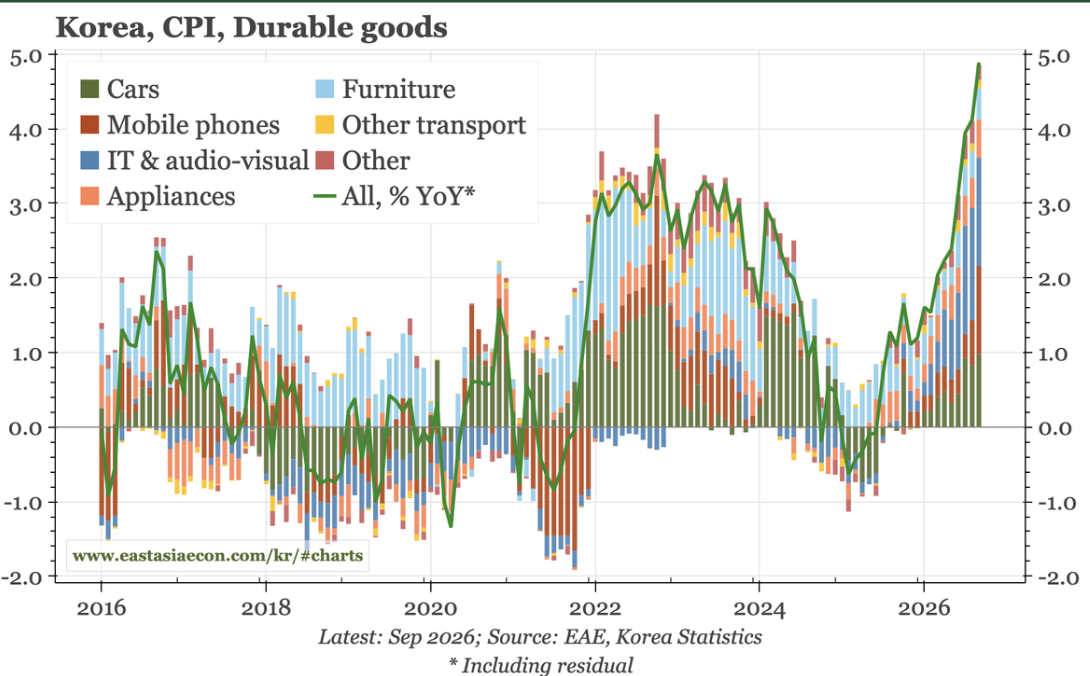
Korean headline CPI dipped in September as base distortions faded, but Paul Cavey warns that underlying price pressures are expanding. Cost-push forces dominate for now, driven partly by broad energy contributing 0.8ppts to the yearly headline print. Durables price inflation has hit its strongest pace since 2009, reflecting the pass-through of soaring semiconductor prices into downstream electronics. Computer prices are advancing at more than 20% year-on-year, and Paul expects upward pressure on durables to persist as export volumes and the trade surplus expand. Rising chip prices are driving nominal GDP growth to around 30% in the third quarter, creating an income surge that feeds households through stockmarket wealth effects, fiscal spending, and corporate bonuses. While weak labour data currently restrains domestic demand-pull forces, the BOK expects demand-side pressures to widen alongside cost shocks, keeping inflation risks elevated.
South Africa: SARB catch-up hike precedes long policy hold
The SARB unanimously lifted its policy rate by 25bp to 7.25% in a move the analysts characterise as a catch-up reaction after July’s policy mistake. Peter Montalto argues that the sudden return to a risk-management approach was driven by a belatedly raised fuel path flowing directly into core inflation, alongside two hawkish scenarios that spooked the committee. While the MPC’s updated quarterly projection model shifts to a higher-for-longer trajectory with end-2027 rates at 6.34%, Peter stresses that this move does not inaugurate a persistent hiking cycle. Instead, he maintain a baseline view of a prolonged hold, pencilling in the first rate cut for July 2027. However, late January carries meaningful upside rate risks should the fuel shock persist or El Niño conditions deteriorate, keeping policy firmly positioned at 7.25% through the first half of 2027.
Commodities
Bitcoin to 140k minimum
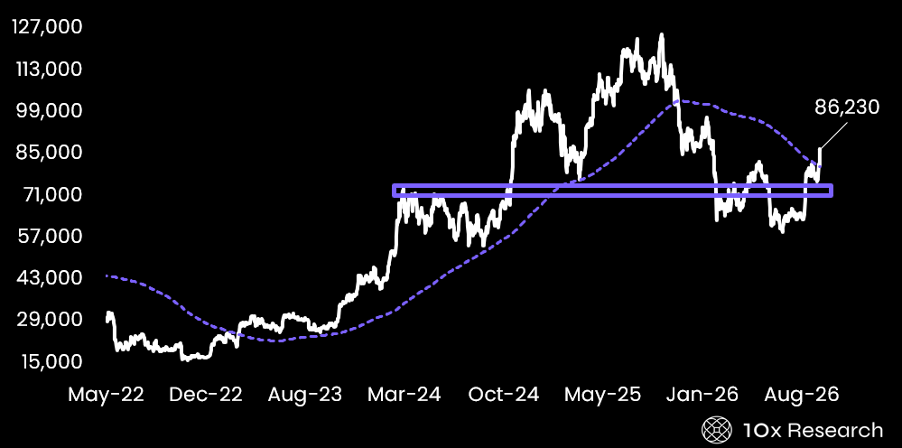
Markus Thielen points out that Bitcoin bottomed at US$63,000 in August, as he expected, during a quiet stretch when few people were paying attention. It has since climbed above 82,000. For now, the Fed is keeping money flowing, and that Markus says supports assets like Bitcoin. To judge how far this rally could go, he looks at the average price that investors (not miners) paid for their Bitcoin. That average is about 76,900 today, so the typical investor is sitting on a 12% gain. In past cycles, broad selling usually didn't start until investors were at least 85% in profit. That level is roughly 142,000 today. Markus therefore has a minimum target for this bull market of around 140,000 to 145,000. He doesn't expect to get there quickly, but the message is for people to stay invested and not let short-term news shake them out.
Why oil prices remain exposed to another sharp rise
Vandana Hari warns that market optimism over a US-Iran truce has run ahead of reality, concluding that a diplomatic off-ramp is not yet in sight. The team doubts Tehran’s fast-tracked proposal contains the elements needed to break the fundamental deadlock over administrative control of Hormuz or sway President Trump. Vandana assigns roughly 80:20 odds that talks drag on and peter out, triggering renewed military escalation, over another fragile deal that fudges navigational protocols. Crude futures will remain volatile and highly sensitive. If Washington and Tehran fall back into their current impasse, Brent should fluctuate broadly in the $90-100 range as long as Hormuz flows sustain around 10 million b/d. However, risks remain skewed to the upside, with Brent positioned to retest $110 if tanker attacks escalate or the Houthis inflict fresh disruption on Saudi oil infrastructure.
Not all copper deposits are made equal
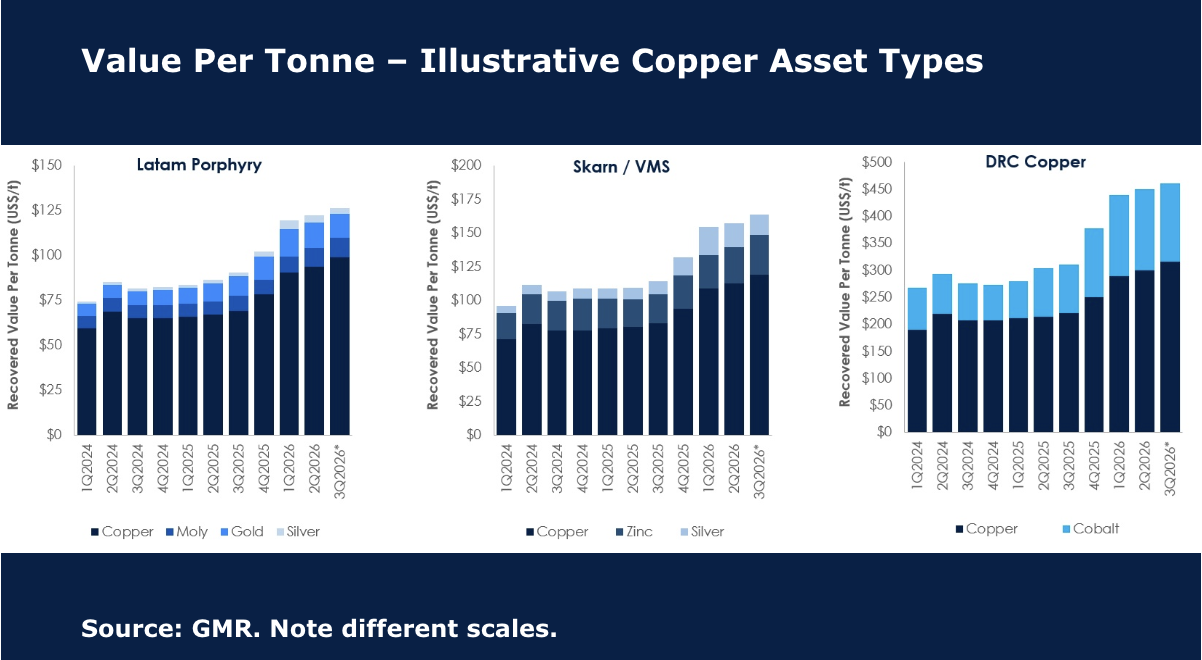
With only days remaining of 3Q 2026, David Radclyffe expects the copper price to show a record quarterly average, estimating LME cash has averaged US$6.37/lb alongside a 2% Comex premium. Whilst copper prices climbed 6% quarter on quarter, the team highlights significant credit volatility: gold slipped 5% and silver dropped 15%, whereas molybdenum strengthened 4% and zinc surged 10%. Across illustrative deposits, in situ recovered credit values range from 20% in Latam porphyries to 30% in the DRC, whilst Grasberg commands precious metal credits near 40%. David argues that the market focus on costs must be examined against value per tonne, with illustrative asset values increasing by 70% since 1Q24 to mark the highest in situ value across the period. Heading into quarterly reporting, primary challenges remain cost inflation and severe Chilean winter storms. Still, at least the margins are great.
Can Korea unlock US nuclear?
Alex Czinner and Harry Swanson report that South Korea plans to deploy eight large reactors on US soil under a $120 billion framework funded from strategic tariff deal commitments. While six units are Westinghouse AP1000s, Alex and Harry argue the two Korean-designed APR1400s matter more, as getting them into the US requires reopening a settlement Westinghouse and KHNP only signed last year. The revision under negotiation would let up to two APR1400s into the US, strictly limited to projects financed through Korea strategic investment. To play this, Alex and Harry highlight Fermi America, which holds the only programme-linked site with an active NRC combined licence review. Across the supply chain, Doosan Enerbility provides critical heavy forgings and BWXT supplies components alongside engineering services. Cameco captures long-dated upside via its 49% stake in Westinghouse, benefiting from licence fees, fuel assemblies, and roughly four million pounds of annual uranium demand.