Europe
Consumer Discretionary
ALE is evolving from a pure marketplace into a broader commerce-enablement platform, which could deepen seller dependency and create new high-margin revenue streams beyond take rates. Opening logistics, payments and advertising tools for off-platform use should expand ALE’s addressable opportunity, while greater verticalisation could improve conversion in high-intent categories and strengthen its position against specialist competitors. The new seller-protection programme and App Store should further raise switching costs, while Allegro XL addresses a structural gap in bulky-goods ecommerce and could unlock incremental GMV while reinforcing the Smart ecosystem. Combined with international expansion and AI-driven efficiency, The IDEA! believes the strategy should support a more diversified, higher-quality earnings profile and reinforces their positive stance.
Healthcare
Chronic strength outweighs acute pain - the market is focusing too heavily on Kerecis and overlooking the resilience of the core franchise. Chronic Care, which represents ~75% of sales, continues to deliver ~7% organic growth, supported by high switching costs and leading market share, while Interventional Urology has also grown at a HSD pace. Kerecis remains the main problem, with outpatient activity hit by the new Medicare reimbursement regime, but inpatient growth remains healthy and management is now targeting recovery by 2Q27. Consensus has essentially given up on margin recovery, but AlphaValue thinks that is too pessimistic and expects gradual improvement as FX and plant ramp-up costs roll off. The shares are trading at their lowest valuation in more than a decade and offer a 5.3% dividend yield, the highest in the sector. TP DKK644 (55% upside).
Industrials
ACS is AIR’s top European infrastructure-building pick, supported by strong earnings momentum, a rapidly growing order book and significant hidden value. H1 sales rose 8.5% Y/Y and EBITDA 12.8%, while new orders increased 15.3% to €36.5bn and the backlog reached €105.8bn, with AI/Tech the largest source of new business. The balance sheet has also strengthened materially, moving from €2.2bn net debt a year ago to €1bn net cash, while 2026 net profit guidance implies ~35% growth. The key valuation argument is that ACS’s 80% stake in Hochtief is worth ~€26.5bn, effectively leaving the rest of the group valued at only ~€1.5bn. AIR expects data centres to drive near-term growth, followed by energy infrastructure and longer-term nuclear opportunities. TP €140 (50% upside).
Technology
A powerhouse AI optical franchise trading at a telco multiple - optical revenue grew 20% Y/Y in Q2, while AI & Cloud revenue more than doubled and orders reached €2.8bn, with roughly half expected to convert within 12 months. Nokia has already won meaningful share in scale-across (the hardest AI interconnect layer to displace once designed in), while scale-out and eventually scale-up provide further growth legs. Capacity is also being expanded materially across US Indium Phosphide laser, test and packaging facilities. With Optical Networks now ~20% of group revenue and Nokia also increasingly selling Ethernet switches and routers into intra-data-centre applications, Rosenblatt’s SOTP analysis (which implies ~50% upside) values one-third of Nokia as AI infrastructure and two-thirds as telco. They see that as conservative because this reflects the current mix, while AI infrastructure should become a much larger share of the business over time.
North America
The high price of high volatility
Investors are paying near dot-com-era prices for high volatility stocks despite fundamentals that remain exceptionally weak. These companies trade at 5.2x sales vs. 3.1x for low-volatility stocks, while the high volatility cohort averages just a 31st-percentile ranking on KCR’s Aggregate Score - a level seen in only 24 of 449 months since 1989. Consensus long-term EPS growth expectations are now 54%, in the 99th percentile and above March 2000, even though current sales growth is only around the cohort’s historical median. Sentiment is also stretched, with short interest at a 23-year low. Strip out the few large winners and the typical high volatility company has a -371% net margin, negative FCF yield and dilutes shareholders by ~6% annually. Low volatility offers the far better valuation / fundamental trade-off. Click here to access the full report, including a list of KCR’s Top & Bottom Ranked Stocks.
Words matter
Trivariate analysed earnings-call language from January 2011 onwards across the 1,000 largest US equities by m/cap to identify which communication patterns contain investable information. Management has become increasingly “flowery”, but mainly because numerical references have fallen sharply rather than adjective use rising. The strongest signal is that “numbers speak louder than words”: companies with high adjective-to-number ratios subsequently tend to underperform, with the effect particularly strong in Industrials and Materials and driven mainly by the outperformance of low-ratio companies. Forward-looking and positive Q&A commentary can also be constructive. Quantitatively derived stock ideas include Boeing, Corning, Parker-Hannifin, Starbucks and Cummins on the long side, while IBM, Valero, Constellation Energy, HCA and Grainger appear among the shorts.
Consumer Discretionary
HNI’s headline growth and EPS guidance are almost entirely a function of the Steelcase acquisition and a series of one-time items, including a tariff refund accrual and a lower non-GAAP EPS base, rather than an inflection in demand. Meanwhile, the order and backlog disclosures that management uses as evidence of inflecting demand are too inconsistent to independently verify. As a result, Corto believes that the company’s full-year revenue outlook - which calls for significant inflection and acceleration in H2, with little fundamental support - will be difficult to achieve. With the shares rallying by 60%+ since the company’s May lows (which came on the tail end of the company’s weak start to the year), Corto sees meaningful downside risk to shares, particularly if Q3 results fail to show any acceleration in revenue growth.
Consumer Staples
John Zolidis argues SFM is still misunderstood by the market, which continues to treat it like a conventional grocer. Instead, he sees the company as a high-ROIC compounder, with its differentiated assortment and focus on health-conscious consumers supporting stronger structural margins, better inventory turns and higher FCF than typical food retailers, while that customer base should also grow faster than the broader population. At just 12 P/E and 7x EV/EBITDA, the shares are trading at discounts to historical averages and cheap multiples on an absolute basis. In a return matrix John estimates one-year upside potential of 50% with a 10x EV/ EBITDA multiple vs. 15% downside using a 6x multiple. He would take advantage of recent weakness to add to or establish new positions in SFM.
Tokenised Equities: Liquidity is arriving before regulation
Financials
The failure of the CLARITY Act to advance leaves the regulatory discount on tokenised equities unresolved, but the bigger signal is that digital stock settlement is already developing meaningful liquidity outside traditional market hours. Tokenised versions of listed equities traded $7.9bn last month, including $1.01bn over Labor Day weekend while traditional exchanges were closed, with digital shares still trading at discounts to their conventional counterparts. Nasdaq’s $100m investment in Kraken’s parent to build stock-settlement infrastructure reinforces the idea that incumbents are preparing for a more digital market structure. The Bridge sees the longer-term risk in 24/7 settlement and tokenised derivatives eroding pricing power across exchanges, brokers and listed-derivatives platforms.
Healthcare
The Phase III HORIZON miss for Novartis / Ionis’s pelacarsen has created a much tougher setup for competitor AMGN, but the key question is how much of that failure should now be reflected in AMGN’s LP(a) candidate (olpasiran) ahead of its Phase III OCEAN(a) trial. The downside may now be relatively limited given how aggressively the market has written off the class, while the upside could be substantial if the full HORIZON dataset supports only a limited read-through and investors have over-discounted olpasiran’s chances. Foveal's latest work focuses on what the full dataset could mean for that AMGN risk-reward, as well as whether there is any residual value to salvage for NOVN / IONS.
Healthcare
Paragon views new CEO Jason Weidman as the right leader to fix the underperforming Interventional business and rebuild margins. Their analysis includes interviews with former senior Medtronic executives who worked with Weidman for more than 84 years combined, with feedback overwhelmingly positive. He is described as analytical and commercially fluent, prioritising profitability over sales growth, making decisions from financial models and developing managers before delegating to them. The main weaknesses are that he can become overly focused on the newest asset in a portfolio at the expense of established products, may be slow to replace underperforming leaders and has limited deal experience beyond assessing targets brought to him by others.
Healthcare
Hamed Khorsand views TWST as a growth-trap short, arguing the market is assigning software-like economics to what remains a capital-intensive life-sciences manufacturing business. The stock trades at ~17x 2026 revenue, well above profitable peers such as Agilent and Danaher, despite persistent cash burn and gross margins that Hamed believes are approaching a ceiling around the low-50s. Competitive pressure is also intensifying as integrated incumbents bundle NGS probes with broader reagent and library-prep offerings. He also sees the August share-price surge on Anthropic’s protein-design work as overdone, noting TWST was an independent evaluator rather than a strategic or commercial partner. Insider selling accelerated into the rally, while the recent equity raise highlights ongoing funding needs. 12-month TP $45 (65% downside).
AI Security: Green shoots are sprouting!
Technology
Marker Advisors’ channel work suggests the best is yet to come for AI security, with pipelines building faster than current sell-through. Partners expect incremental progress in Q3, but a more meaningful inflection in Q4 followed by acceleration through 2027 as new budgets come through. Customer interest in securing AI and AI agents is already substantial, with agent discovery the immediate priority. The earliest beneficiaries should be vendors with the greatest reach and lowest deployment friction, particularly CrowdStrike, Okta and Palo Alto. SOC automation is also emerging as a key competitive battleground, with PANW, CRWD and SentinelOne among the early leaders, while data sovereignty in Europe and greater board-level scrutiny are creating additional demand.
Technology
AVGO’s AI growth remains exceptional, but Veritas argues the financing behind that demand is becoming increasingly important. In addition to their previously identified $29bn backstop of a customer’s lease obligations, Q3 disclosures show the customer may issue AVGO up to $42bn of convertible promissory notes, with proceeds restricted to lease payments. AVGO may also provide residual-value guarantees, leaving it exposed to the customer’s ability to pay and, in a default, to the resale value of AI racks. Management says the platform could support more than 20GW of compute through 2028, versus ~1GW initially. Veritas’ concern is that the financial support underpinning hardware sales is expanding alongside AI growth, while much of the potential exposure remains in the footnotes.
Asia
Consumer Discretionary
Iii’s channel work raises questions over whether Meesho’s improving reported unit economics are as durable as management suggests. Experienced e-commerce operators argue that logistics efficiency, rather than advertising, is the key determinant of marketplace profitability. While management reported another sequential decline in logistics cost per delivered order in 1Q27 despite higher fuel and wage costs, Iii’s channel work suggests defect rates remain above industry benchmarks, potentially offsetting those savings through higher return-handling and refund costs. With roughly two-thirds of GMV-contributing sellers already advertising, further ad growth increasingly depends on pricing and inventory mix, making Meesho Mall important to the next leg of monetisation. Iii sees logistics cost per delivered order as the key test: another decline would support management’s case, while a flat or rising print would strengthen the sceptical channel view.
AI security & the China factor
Technology
86Research sees limited risk of a major near-term slowdown in US AI investment, arguing Washington is unlikely to impose deep unilateral restraint while Chinese labs continue scaling. Any safety regime is therefore likely to involve tighter gates and some pacing but remain relatively soft and reversible. For China tech, negotiations could still trigger periodic shocks through threats of tighter semiconductor, equipment and overseas-compute restrictions. Longer term, however, a slower model cycle could shift value away from repeatedly building frontier models and towards deployment, favouring domestic inference chips and AI applications. It could also reduce the premium attached to leading model developers while giving catch-up players such as Tencent more time to close the gap.
Developed Markets
AI: The wolf that cried wolf
The BCA team believes recent apocalyptic warnings from AI leadership are a calculated marketing stunt rather than genuine existential concern. Tech leaders are embracing fearmongering to justify astronomical private valuations, erect regulatory capture barriers against Chinese open-weight models, and rally Washington around national security. More critically, the team contend that OpenAI and Anthropic are on the hook for hundreds of billions in committed capex whilst running dangerously low on liquid cash. In this scenario, doomer hype serves as a convenient, face-saving corporate exit ramp to renege on massive commitments to build datacentres and purchase GPUs before unavoidable bills come due. For institutional investors, this performative handwringing signals that the peak in the AI capex cycle has arrived. Rather than demonstrating genuine corporate responsibility, frontier models are preparing to walk out on the check and dine and dash on the business cycle.
The UK’s structural deficiencies laid bare
Graham Turner notes that the Labour Government has acknowledged, privately, that its own policies have contributed to a rise in the NAIRU. Wage inflation is nudging up again despite a higher rate of unemployment. Critics have been forced to revise up growth projections. The flipside will be higher inflation. Indexed-linked yields continue to rise as investors fear the fallout for fiscal sustainability from higher inflation. The default to easy options on fiscal policy remains: a tourism tax will be seen as another soft route for funding local government services. PM Burnham will have to contend with the reality of a rising deficit in trade and concerns about government spending. Cars, food and energy are structural soft spots for the UK economy, with all three showing record trade deficits this year. Graham says that the key vulnerabilities in the UK economy point to a much weaker exchange rate in the longer term.
A messy turn for the French presidential race
According to Wolfgang Munchau, renewed gilets jaunes protests and a debt spiral could reshape the French presidential election campaign. Neither the far-left and the far-right parties seem keen on another gilets jaunes movement. One of the arguments of the left is: This is not the time to fan the flames: the time to show anger is at the ballot box. It could pitch a law & order constituency against those who advocate radical change. Meanwhile, fiscal constraints are biting too. Rising interest rates and weak economic growth are the ingredients of a vicious cycle that increases the efforts required to stabilise debt, while the economy is producing less to ensure the revenues the state needs to pay for this rising expenditure. Wolfgang warns that these two forces (street protests and the threat of a debt spiral) could interact and reinforce each other. Becoming president sounds much less like a dream job.
Worries evermore
Ed Yardeni notes that there is no shortage of worries for investors in the current environment. The list includes higher oil prices amid escalating tensions in the Middle East, rising bond yields around the world, sticky inflation, and the risk of a tighter monetary policy stance. Nevertheless, Ed is sticking with his bullish year-end target for the S&P 500 of 8400 because a key pillar of the bull market, Fabulous Earnings Momentum (FEMO), remains alive and well and so does his base-case Roaring 2020s scenario. The essence of that scenario: a technology-driven productivity boom, fuelled by AI and other innovations, will allow the economy to grow faster as it also contains inflation, boosts real wages, and supports record-high profit margins and earnings growth. However, the recent confluence of risks has prompted Ed to lower the subjective probability he assigns to the Roaring 2020s scenario from 80% to 70%, while raising the probability of outcomes that could derail this happy scenario to 30% from 20%.
US: On the topic of yields
Michael Howell refutes the widespread belief that rising bond yields signal investor concerns about runaway fiscal deficits or a loss of confidence in US Treasuries. Bond yields are undoubtedly rising, but he says that this is a global phenomenon, with China the notable exception. If investors were genuinely becoming concerned about sovereign solvency, excessive debt burdens or the erosion of Treasury safe-asset status, term premia would be widening materially. They are not. The narrative of a Treasury market losing its reserve status is therefore not merely premature; it is increasingly inconsistent with the available evidence. Michael says the 3-3-3-30 Framework is more than a debt-management strategy. It is a roadmap toward faster monetary inflation, stronger nominal growth and structurally higher equilibrium bond yields. The challenge for policymakers is not preventing yields from rising. It is preventing the adjustment from becoming disorderly. For investors, that distinction may prove decisive. In short: the can is being kicked down the road.
US: Before the consensus catches up
Markus Thielen points out that current forecasts put Democrats' odds at roughly 59% for the Senate and around 86% for the House. A Democratic sweep would put real pressure on Trump's policy agenda: the legislative agenda would largely stall, oversight and investigations would ramp up sharply, and government funding fights would intensify. Congress's more effective lever may not be war powers resolutions, which Trump can simply disregard, but the power of the purse. A Democratic House and Senate, even one not seated until after the midterms, could attach conditions to the $200bn in requested war funding or refuse to fund continued operations outright. The probability that Democrats control the Senate could prompt markets to price in a more fiscally restrictive Congress, one that curbs the bond market sell-off and limits the scope of the Iran conflict, which, in turn, could pull oil prices and bond yields lower. That combination would support a Q4 equity rally, which is why Markus remains constructive despite a potential short-term hiccup.
US: Billionaire politics
Charles Hess observes that megadonors to this year’s US political campaigns favour Republicans by about 4:1. According to estimates reported in the media, billionaire donors are contributing $844.5bn to Republican campaigns, while they are providing $211.9bn to Democratic campaigns. Charles comments that it is hardly surprising that extremely wealthy donors tend to be more supportive of the Republicans. In contrast, Charles also notes that of the households who visited an Ohio food bank, more than half said they were forced to choose between paying for utilities or paying for food. In households with children, the number was 65%. Meanwhile 48%said they had to choose between affording medicine or food. Charles comments that while market and asset increases continue to boost many households’ assets, trade-offs continue to be a way of life for many people in what he refers to as the Desperation Economy.
Korea: The rising tide
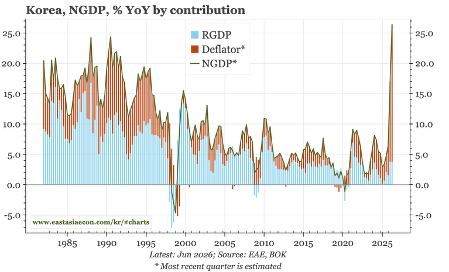
Paul Cavey notes that in Q2 real GDP provisionally grew 3.7% YoY, much higher than potential growth, which the BOK estimates at just 2%. However, nominal GDP grew 26.4% YoY in Q2, despite real GDP growth and inflation both remaining in low single digits. Reflecting the semiconductor price boom, the biggest part of the terms of trade boost has so far accrued to corporates. This rapid rise in income doesn't guarantee faster growth in real GDP. That instead depends on whether the income windfall is spent (and the extent to which any of that expenditure leaks out in the form of higher import demand). The spillover from the rise in incomes into real GDP will, in turn, determine how far yields are likely to be lifted. The BOK is optimistic that this feedthrough will occur, as consumption patterns in the two geographic areas of Korea where the chip sector is concentrated indicate that the semiconductor boom is already having a positive effect on domestic consumption.
Emerging Markets
LatAm’s turn next?
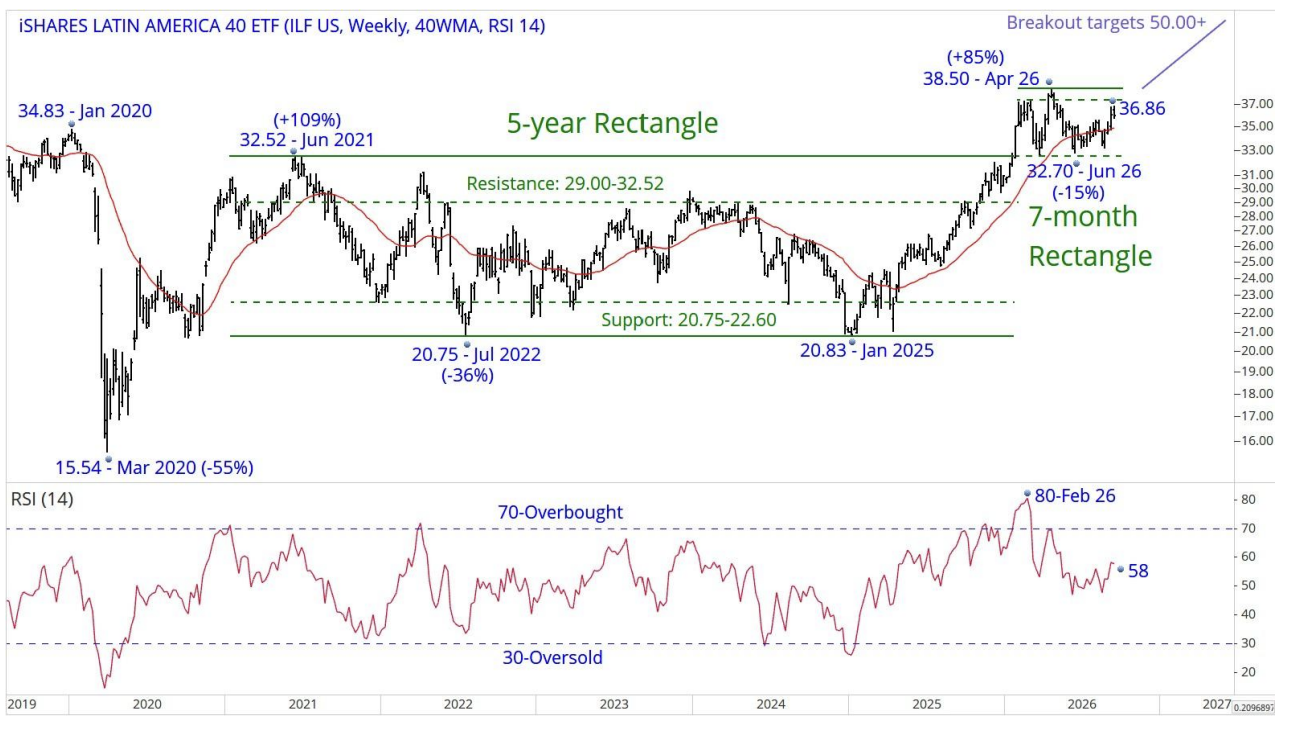
Chris Roberts points out how the iShares Latin America 40 ETF (ILF US, USD35.97) is breaking out after a nearly 18-year Down-Channel and a 75% drop from its 2008 peak. January’s channel breakout has held, with price finding solid support along the rising 20-month WMA and former downtrend line. The weekly chart confirms a breakout from a 5-year Rectangle targeting USD50.00+, backed by the 14-week RSI hitting Very Overbought 80, signalling a structural trend shift. A push above April’s USD38.50 high reinforces this bullish setup, whilst a weekly close above USD39.50 would complete a 7-month Rectangle targeting USD45.00+. With the index heavily depressed for nearly two decades, the USD50.00+ target looks achievable, paving the way for an eventual test of the USD60.00+ peak. The weekly chart breakout saw 14-week RSI reach Very Overbought 80, an important change in behaviour, which supports the idea of a change in trend.
Brazil: Fiscal reform will anchor duration
Niall Ferguson is bullish on BRL/USD and local currency duration, arguing that Brazil's sovereign debt market is exhibiting signs of deep distress with the government debt market flashing red. While Brazil's fiscal trajectory appears unsustainable, analysts believe investors will start questioning the direction of travel absent reform, yet they maintain high confidence that whoever wins the presidential election - Luís Inácio Lula da Silva or Flávio Bolsonaro - will focus on fiscal adjustments. Unlike in pre-Milei Argentina, a long-established political consensus exists not to let the plane crash into the mountain, leaving default extremely unlikely at under 1%. Niall views Brazilian local rates as offering attractive risk-adjusted returns, with shallow fiscal reform emerging as the most probable post-election path. With term premium differentials driving their real effective exchange rate model, Niall sees limited downside risk and recommend positions across local currency duration and BRL/USD.
China: August macro releases were mixed
Industrial production in China beat estimates but consumption and investments deteriorated further. Industrial production rose 5.2% y-o-y in August and 5.3% in 8M/26, led by high-tech and export-oriented manufacturing. Retail sales growth slowed for a second consecutive month to 0.4%. The main drags were automobiles, gold and furniture, partly offset by communication devices and tobacco and alcohol. Fixed asset investment (FAI) contracted 7.2% in 8M, decelerating for a sixth straight month. High-tech FAI was the sole bright spot at +5.2%, but was outweighed by declines in infrastructure, manufacturing, and property investments. Private investment (-10.1%) continued to lag public investment (-3.6%). The surveyed jobless rate edged up to 5.3%. In the property sector, residential property sales fell 13.1% y-o-y in 8M/26, while property investment slumped 19.9%. New home sale prices decreased 0.17% m-o-m in August. Only 21 of 70 cities recorded stable or higher new home prices. A durable recovery in property investment is unlikely before prices stabilise and inventories normalise.
China: Beijing’s monetary policy dance
Dinny McMahon points out that Beijing has promised to support the economy with “counter-cyclical adjustments” to its monetary policy – but he is confident this won’t include rate cuts. This is because the PBoC is desperate to preserve bank net interest margins (NIMs), which slipped to 1.41% at end-June as bond-market migration drove early loan repayment and repricing. Relief instead flows through two channels: large firms migrating from bank loans to cheaper bond financing, and smaller firms getting interest-rate subsidies and relending quotas. This policy support is generous and underused, so Dinny expects Beijing to focus on deployment and maintaining liquidity in the bond market. He expects 10-year Chinese government bonds to trade at 1.6-1.8%, with H2 liquidity needs managed via open-market operations and the PBoC’s medium-term lending facility. This is because an RRR cut would either erode bank NIMs or flatten the yield curve as banks deploy the freed liquidity into long-dated bonds.
Colombia: A steep slowdown ahead
One month into Abelardo de la Espriella’s presidency, Marcos Buscaglia believes that GDP growth reached its zenith in 2Q-2026 and is bound for a steep slowdown in coming quarters. Although Abelardo has consolidated political control, securing 63 of 103 senators and 110 of 182 representatives across eleven coalition parties, reconstruction challenges following an earthquake three days after taking office complicate his announced fiscal discipline. The team expect Abelardo to pass a revised budget targeting a 7.2% of GDP deficit in both 2026 and 2027, backed by a bill aiming to improve the 2027 result by 2.2 percentage points of GDP alongside discretional spending cuts. With the current account deficit expanding to 2.4% of GDP as of 2Q-2026 despite favourable terms of trade, Marcos expects some minor depreciation in the COP alongside a final rate hike in September as they raise their 2026YE inflation forecast to 6.8%.
Taiwan: Making the best of the good times
Niall Fergusons’ team spent a week in Taiwan, meeting with a diverse group of senior contacts. Theycame away optimistic about 2027, anticipating booming growth, continued progress on societal resilience and deterrence against a cross-Strait invasion, and a relatively low-key presidential election in January 2028. Contrary to public reporting, relations with the United States are the best in decades. Knowledgeable officials are optimistic that an invasion is and will remain deterrable, particularly as Taiwan’s drone industry scales up. However, looking past next year, Taiwan faces major challenges. There is a structural energy shortage. The economic miracle is driven mainly by a single company: TSMC. Beijing’s grey-zone campaign is also accelerating. If President Lai Ching-te is re-elected, Niall’s current base case, Beijing has positioned itself to move swiftly toward a quarantine of Taiwan’s foreign trade. Investors should pay close attention not just to China’s grey-zone moves, but to changes in Washington’s public responses to them.