Following analysis of WTB’s FY26 annual report, Iron Blue raises their risk score +2pts to 26/60.
Following analysis of WTB’s FY26 annual report, Iron Blue raises their risk score +2pts to 26/60. This principally reflects another rise in stripped-out expenses (£185m of one-off costs were excluded from headline earnings vs. £116m in FY25, equivalent to 38% of adj. PBT) and associated use of provisions accounting, as well as increased interest expense capitalisation (£23m vs. £9m in FY25). The gap between capex and the P&L depreciation charge also remained elevated (£276m or 57% of adj. PBT), with depreciation still running well below historical rates. Management also flagged two new principal risks: the impact on the group’s sales strategy from the rise in AI-led customer search platforms as well as the impact of real estate market softness on its property disposal programme.
ResearchGreece turns bullish after modelling the proposed Fibank acquisition, arguing the deal is strategically attractive, sensibly priced and accretive despite the associated capital raise.
ResearchGreece turns bullish after modelling the proposed Fibank acquisition, arguing the deal is strategically attractive, sensibly priced and accretive despite the associated capital raise. EUROB will initially buy 65% of Fibank for €650m and expects to reach at least 83% ownership for €830m, valuing the Bulgarian lender at ~0.95x tangible book and 8.4x normalised pre-synergy earnings. Funding will include a €750m share issue, implying ~4.4% dilution, but ResearchGreece still sees forward EPS accretion of ~4.0-4.7% by 2028-30 under conservative assumptions. The transaction should preserve EUROB’s ~17% RoTE profile and 55% payout, while CET1 rebuilds from ~13.8% at closing to 14.2% by end-2027E and 14.5%+ by 2029E. TP €6.1 (~30% upside).
DSV’s acquisition of DB Schenker represents not only its largest deal to date but also its most challenging integration, particularly given the unprecedented scale of the Road business it is absorbing.
DSV’s acquisition of DB Schenker represents not only its largest deal to date but also its most challenging integration, particularly given the unprecedented scale of the Road business it is absorbing. Management says the operational problems are largely fixed, but channel checks suggest regaining lost volumes may require 10-15% price cuts, while Road working capital has deteriorated sharply. In addition, air and sea appear to be overearning, with volumes also a concern. Recurring accounting questions remain around accruals, segment FTE movements and Schenker provisions. With the shares back near ~20x, the valuation leaves limited room for execution slippage; future M&A is likely to be less accretive, while competitors may be better placed to capture AI efficiencies as DSV first has to unify its systems. TP DKK875 (35% downside).
EVK may have rejected its best available option by turning down BASF’s €24-per-share proposal, leaving management with the burden of proving that independence can create more value after years of weak returns.
EVK may have rejected its best available option by turning down BASF’s €24-per-share proposal, leaving management with the burden of proving that independence can create more value after years of weak returns. Return on capital has fallen from 12.8% in 2015 to 3.9% in the latest twelve months, while earnings have repeatedly missed initial expectations. SSR also questions whether protecting independence ultimately protects jobs, given continued weak returns could force deeper restructuring later under worse conditions. BASF is now likely to look elsewhere, while the broader message is that the European chemicals sector needs consolidation, credible asset restructuring and a competitive policy framework.
Forensic Alpha flags a rapidly expanding balance sheet, raising questions over how the group’s business model is changing and what risks investors may be missing.
Forensic Alpha flags a rapidly expanding balance sheet, raising questions over how the group’s business model is changing and what risks investors may be missing. Non-current contract assets rose 58% in the first nine months of 2026 as more revenue was recognised on multi-year projects well before the associated cash is expected, while inventories jumped 75% to €667m as BC8 increasingly holds stock for customers under call-off agreements. Customer prepayments have not risen alongside this build, leaving the company to fund much of the working capital burden itself. Working capital absorbed €456m of cash in nine months, resulting in negative OCF of €131m, while a €450m Schuldschein issuance largely funded the outflow and net debt rose from €21m to €448m.
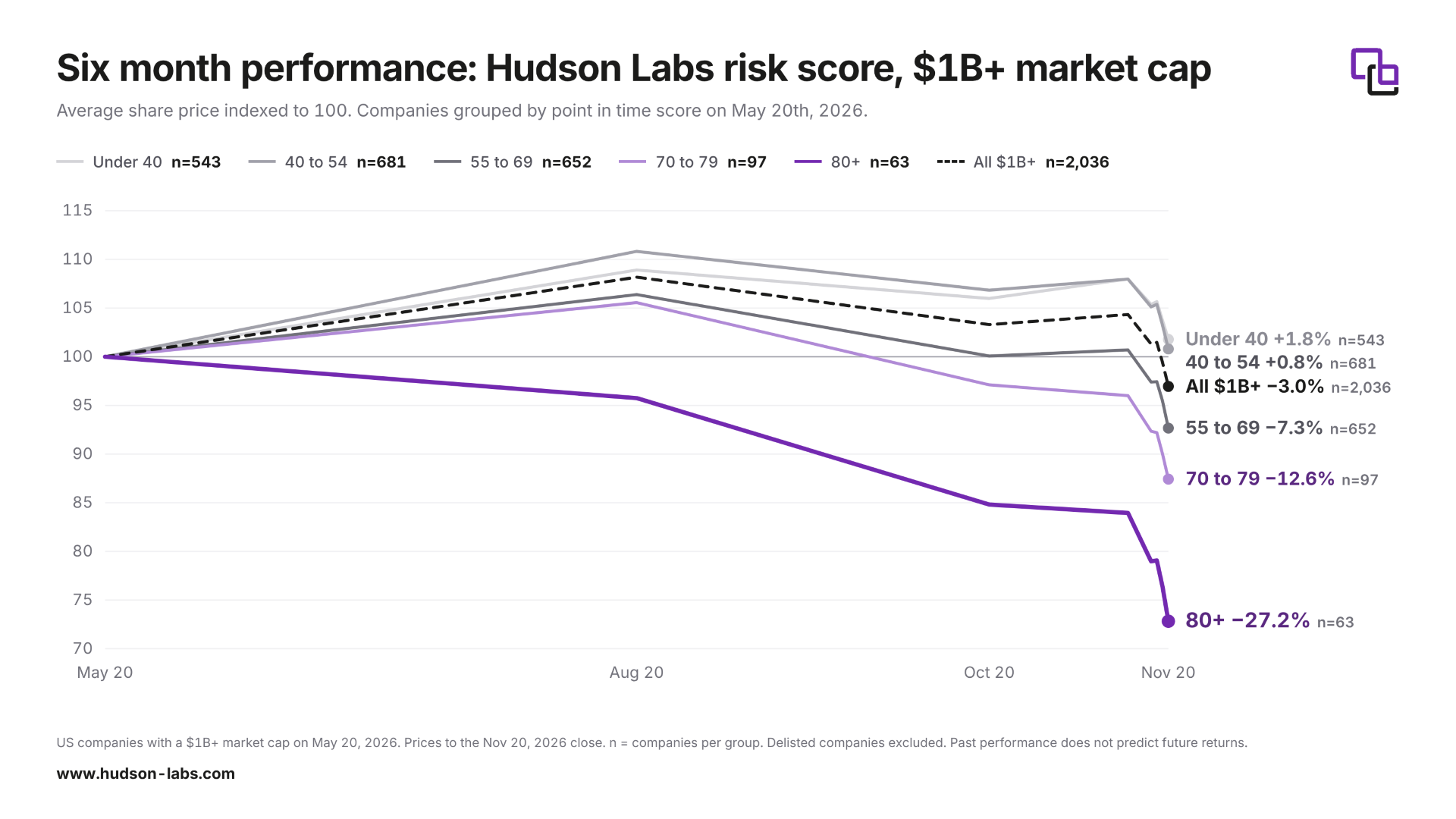
Hudson Labs’ Forensic Risk Score uses LLMs to quantify risk and predict fraud, and has shown a striking separation in stock performance.
Hudson Labs’ Forensic Risk Score uses LLMs to quantify risk and predict fraud, and has shown a striking separation in stock performance. Among US companies with market caps above $1bn, the high-risk basket (companies scoring 80+) fell 27.2% on average over the past 6 months, while the lowest-risk group (scoring below 40), rose 1.8%. The chart shows how performance deteriorated progressively as risk scores increased. Which of your holdings score 80+? Contact us below to book a demo.
HRC’s latest Southern California tour confirms the housing slowdown they saw in Dallas, with 7%+ mortgage rates leaving many builders sitting on excess completed inventory and little new construction underway.
HRC’s latest Southern California tour confirms the housing slowdown they saw in Dallas, with 7%+ mortgage rates leaving many builders sitting on excess completed inventory and little new construction underway. Sales across HRC’s broader tracking are running ~30% below last year, prompting price cuts of $30,000-$70,000, or ~5-10%. They cut unit, margin and EPS forecasts two months ago: FY27 EPS estimates are ~25-70% below the street for most builders, with even larger gaps at several smaller names. HRC expects further share price weakness as Q4 results and weaker 2027 guidance force consensus estimates lower.
Daniel Biolsi sees further rotation out of Tech/AI into selected Consumer names offering better earnings visibility, company-specific catalysts and meaningful upside.
Daniel Biolsi sees further rotation out of Tech/AI into selected Consumer names offering better earnings visibility, company-specific catalysts and meaningful upside. Keurig Dr Pepper is highlighted ahead of its planned 2027 separation; Daniel sees ~20% upside pre-split, increasing towards 50% when incorporating 2027 earnings, FCF driven deleveraging and potential multiple expansion. Celsius also offers an asymmetric setup: the investment case works even without further market-share gains, while easier comps, SKU restoration and margin recovery could see 33%+ upside in 2027 and 50%+ upside in 2028. Sensient is another standout, with the shift from synthetic to natural food colours by the end of 2027 creating a potential $1bn+ revenue opportunity and ~50% upside in Daniel’s bull case.
Bios Research has built a strong Healthcare short-selling track record, publishing 200 short ideas over 15 years with a 69% absolute hit rate and 71% generating alpha versus the S&P 500.
Bios Research has built a strong Healthcare short-selling track record, publishing 200 short ideas over 15 years with a 69% absolute hit rate and 71% generating alpha versus the S&P 500. The firm currently has 12 active shorts with market caps ranging from ~$1bn to $75bn+. Their latest idea is a ~$10bn medical-device short where Bios sees slowing growth, excessive expectations and new product launch concerns driving substantial downside before year-end and through 2027. On the long side, they have published 3 new ideas this year and continue to identify several potential M&A targets. Recent conviction removals include Xeris Biopharma, up ~945% since their Oct 23 long call on its underappreciated commercial portfolio and pipeline potential, and CRISPR Therapeutics, down ~30% since their Aug 25 short alert on over-exuberance around Casgevy and the CRISPR/Cas9 platform.
BKD's recent weakness looks more like a temporary macro-driven lull than a broken thesis, with a major demographic demand inflection approaching against virtually no new supply.
BKD's recent weakness looks more like a temporary macro-driven lull than a broken thesis, with a major demographic demand inflection approaching against virtually no new supply. The US 80+ year-old population is growing by ~100,000 annually while only ~10,000 new senior-living units are being added, with meaningful new supply unlikely before 2032-35. Meanwhile, the turnaround is gaining traction after Chairman Denise Warren reset the portfolio, exited non-core markets and improved the operating structure, while FCF has turned positive. A further source of upside sits in the Sunbelt portfolio, where underperforming Texas and Florida assets are depressing consolidated valuation but could recover or be sold. Finally, the shares are overlooked by REIT investors, while short interest is high at ~18%. TP $15 (65% upside).
There has seen a notable cluster of insider buying following results in Oct, with the Chair and two Directors purchasing ~$2m of stock between at ~$170 per share.
There has seen a notable cluster of insider buying following results in Oct, with the Chair and two Directors purchasing ~$2m of stock between at ~$170 per share. Akhil Johri bought $500k in his first purchase since joining the board in 2020; notably, he has never bought shares at Cardinal Health, where he is also a Non-Executive, or at RTX, where he previously served as CFO. Chairman Steven Mollenkopf spent $510k in the largest of his five purchases, while Mortimer Buckley bought $1m, also his largest purchase to date. Smart Insider views the cluster as significant and ranks the stock +1 (highest rating).
Arete initiates coverage with a Buy rating and $300 FY29 target, based on revenue rising from $56bn in 2026 to $663bn by 2030, adjusted operating margins reaching ~36% and FCF of ~$172bn.
Arete initiates coverage with a Buy rating and $300 FY29 target, based on revenue rising from $56bn in 2026 to $663bn by 2030, adjusted operating margins reaching ~36% and FCF of ~$172bn. They see demand continuing to accelerate, with their CIO panel expecting GenAI spend to rise 2.4x in 2027 (a forecast Arete believes could prove conservative). ANT’s early model leadership, rapid monetisation, talent base and capacity scale are expected to help it maintain a dominant position, while distillation gives frontier providers a price advantage across multiple cost/intelligence tiers and CIO work points to limited open-weight adoption. The principal risk is execution rather than demand: existing commitments support ~12.7GW of capacity by 2028, but their revenue forecast requires ~30GW by 2030.
AAOI has signed an LTA with a hyperscale customer that Mike Genovese believes is Amazon, potentially worth more than $10bn over 4 years depending on demand.
AAOI has signed an LTA with a hyperscale customer that Mike Genovese believes is Amazon, potentially worth more than $10bn over 4 years depending on demand. The guaranteed portion includes $1.5bn of 800G transceivers in 2027 and $700m of laser diodes across 2027/28. Combined with its existing ~$500m Oracle 1.6T LTA, $300m+ of CATV sales and ongoing Microsoft 100G/400G business, Mike believes AAOI should at least meet 2027 consensus revenue of ~$2.6bn and EPS of ~$4.25, although his own estimates are higher at $3.0bn and $5.69. Following the recent $550m ATM, he also believes AAOI has most of the capital needed to support ~$5bn of annual revenue. TP $115 target (200% upside).
BTN sees growing downside risk to CSCO's product margins as higher input costs work their way through the balance sheet.
BTN sees growing downside risk to CSCO's product margins as higher input costs work their way through the balance sheet. Product gross margin fell 350bps Y/Y in Q1 and has now declined for 5 straight quarters, yet FIFO accounting may still be delaying the full impact. Raw material inventory nearly doubled Y/Y and work-in-process has risen more than tenfold in 7 quarters, meaning a larger pool of higher cost inventory has yet to flow fully through COGS. BTN also questions the quality of the 7c EPS beat: R&D excluding stock compensation has fallen sharply as a percentage of sales, with a 100bp reduction worth ~3.8c per quarter. With Q2 revenue growth guided lower, BTN sees less scope for the R&D operating leverage that helped support Q1 EPS.
JNK’s field research indicates capacitor failures linked to a material change are affecting power supply units for Nvidia’s Vera Rubin platform at both Delta and Lite-On, with the affected parts believed to be
JNK’s field research indicates capacitor failures linked to a material change are affecting power supply units for Nvidia’s Vera Rubin platform at both Delta and Lite-On, with the affected parts believed to be high-voltage bulk aluminium electrolytic capacitors. The issue comes on top of tight Infineon silicon-carbide supply: JNK’s November Analog Tracker shows SiC MOSFET orders running at roughly twice shipments since June, with quoted lead times of 24-52 weeks. Together, the two constraints are keeping PSU deliveries below requested volumes. Crucially, improving SiC availability alone would not fully solve the problem, with part of the shortfall likely to persist until a qualified replacement capacitor is available.
CRM partner sentiment weakened Q/Q as early Agentforce enthusiasm gave way to tougher commercial realities, direct channel competition and tighter programme requirements.
CRM partner sentiment weakened Q/Q as early Agentforce enthusiasm gave way to tougher commercial realities, direct channel competition and tighter programme requirements. SPR’s checks suggest buyers are increasingly questioning how quickly AI pilots can deliver measurable ROI, while pricing complexity is slowing the move from proof-of-concept to scaled deployments. Core demand also looks softer, with scarce net-new customer wins, more contentious renewal negotiations and growth relying increasingly on expansion within existing accounts. There are also concerns that Salesforce’s direct sales motion and acquisitions could encroach on traditional partner service and integration revenue. Overall demand for generalist Salesforce implementation talent contracted, whereas demand concentrated around specialised data engineering, Data 360 integration, and governance skills needed to clean customer data before AI agents can function safely.
GMR came away more positive from BHP’s South Australian copper site tour, arguing the latest plan to unlock Olympic Dam is far more credible than previous attempts.
GMR came away more positive from BHP’s South Australian copper site tour, arguing the latest plan to unlock Olympic Dam is far more credible than previous attempts. The key near-term decision is the planned 2027 FID on the smelter expansion, which is increasingly necessary as the copper-to-sulphur ratio deteriorates from 2030 and could otherwise constrain production. Carrapateena and Prominent Hill are critical to the strategy, providing nearer-term growth, concentrate to support the smelter and valuable block-caving experience. Olympic Dam itself is now operating more consistently, but the growth path remains capital-intensive and slow. GMR views management's 650kt copper target for 2040 as aspirational, not necessarily realistic. To 500kt would be a strong first step. BHP remains the quality exposure to the sector and following recent share price weakness they upgrade the stock to Buy.
Accenture’s takeover of GSX highlights the growing strategic value of Japan’s cybersecurity industry, with FFRI Security and Digital Arts seen as two attractive listed plays.
Accenture’s takeover of GSX highlights the growing strategic value of Japan’s cybersecurity industry, with FFRI Security and Digital Arts seen as two attractive listed plays. FFRI offers proprietary endpoint and threat-detection technology with growing relevance to government and national-security demand, while GMO Internet Group has increased its stake to ~9.2%, making it a shareholder worth monitoring. Digital Arts has particularly strong competitive positioning, with i-FILTER and m-FILTER holding at least 55% and 68% domestic market share respectively and customer retention of ~90%. Founder Toshio Dogu’s ~16.8% stake could make Digital Arts harder to acquire, but Yuka Marosek sees both companies as attractive standalone investments, with any M&A premium additional upside rather than the core thesis.
Stephen Leung initiates coverage with a Buy rating, arguing the company’s transition into a pure-play cloud business has created a SaaS platform that stands out for profitability among domestic peers.
Stephen Leung initiates coverage with a Buy rating, arguing the company’s transition into a pure-play cloud business has created a SaaS platform that stands out for profitability among domestic peers. The key debate is whether slower growth at mature expense-management product Raku Raku Seisan (up 9.7% Y/Y in H1) signals broader saturation; Stephen thinks not, with newer products such as Raku Raku Meisai and Hanbai still growing above 20%. Management targets 15%+ cloud revenue growth through FY3/29, while further margin expansion should help Rakus reach its Rule of 50 target from FY28. FY26 operating margin rose to 28.8% from 20.8% as advertising fell despite continued revenue growth. Following the divestment of its legacy IT-staffing arm, Rakus is also redeploying capital into adjacent SaaS assets.
African telcos rebounded strongly in Q3, with revenue growth re-accelerating to 17% Y/Y in local currency, EBITDA margins rising to 45% and capex intensity falling to 15%.
African telcos rebounded strongly in Q3, with revenue growth re-accelerating to 17% Y/Y in local currency, EBITDA margins rising to 45% and capex intensity falling to 15%. New Street’s universe (South Africa, Nigeria, Ghana, Kenya, Egypt) generated ~$8.6bn of OpFCF on an LTM basis, up 39% Y/Y. They continue to see robust real revenue growth, margins steadily increasing and declining capital intensity over the medium term. Starlink risk looks limited: Africa is the least accessible EM region, fixed-wireless access should be the more important broadband technology and D2D partnerships could even be positive. Airtel Africa remains New Street’s preferred name, generating roughly double the EBITDA per dollar of capex of its peers. They are also buyers of MTN and Vodacom, which both feature in their GEM Top 10 picks.
A reversal in two global betas that dominated 2026, AI capex and oil, will create a switch between last year's winners and losers.
A reversal in two global betas that dominated 2026, AI capex and oil, will create a switch between last year's winners and losers. Manoj Pradhan notes that last year's losers, whose rates rose sharply due to oil headwinds, face significant rate compression and improving growth, while easing AI capex growth will slow the second derivative of growth and see equities underperform rates in high-yielding emerging markets. Governor Waller's suggestion of a 50bps hike, a Trichet-like mistake following a rout in the Treasury market, has tightened financial conditions sharply and created a better entry point than fundamentals suggest. Manoj argues that high-yielding emerging markets and New Zealand stand out, preferring rates over equities and FX. Top trades favour long South Africa 10y, Mexico 10y, New Zealand 2y, Colombia 10y, US 10y, and Korea 2y, alongside India, Japan, and Spain equities to outperform, plus tentative long positions in ZAR, INR, and BRL at 6.
Paul Krake believes the extraordinary volatility in AI equities is being driven as much by risk management as by concerns about the industry's earnings outlook.
Paul Krake believes the extraordinary volatility in AI equities is being driven as much by risk management as by concerns about the industry's earnings outlook. A concentration of negative headlines, regulatory uncertainty and a hawkish Fed has created an environment where declining prices generate increasingly pessimistic narratives. However, there is little evidence of an impending collapse in infrastructure profitability. Compute remains scarce, GPU rental prices are rising and older chips are being re-leased at attractive rates. The existing construction pipeline should support exceptionally strong earnings across chips, energy and infrastructure through 202-28. Financially weak borrowers may fail without destroying the value of their underlying assets. Paul believes 2018 provides a more relevant comparison than 2000 or 2008. Equity multiples can contract violently without a recession or substantial earnings deterioration. Valuations are becoming attractive, but he doubts that alone will restore confidence. Further downside remains possible, although Paul suspects we have witnessed peak volatility.
Paragon Intel's detailed report covers the global AI data centre value chain across 3,226 interviews and 286 companies, showing order books full into 2028 even as negative interviews outnumbered positive ones in 2026 and
Paragon Intel's detailed report covers the global AI data centre value chain across 3,226 interviews and 286 companies, showing order books full into 2028 even as negative interviews outnumbered positive ones in 2026 and bottlenecks shifted from chips to power, permits and skilled crews. Single-source suppliers capture margin where buyers lack alternatives: DRAM makers reported 85% to 90% gross margins, transformers were sold out four to five years ahead, and new gas turbine slots priced at least 10% to 20% above backlog. Conversely, builders, regulated utilities and lenders carry duration and balance sheet risk where capital commits ahead of revenue or rate-case recovery, while buyers with a second source resist price increases. A slowdown would show first as delivery delays and moved tool slots rather than cancellations where deposits and contract terms protect orders, with hyperscalers shifting from build-out to optimisation and Microsoft RPO against Azure revenue signalling cooling demand.
Tightening financial conditions within the AI complex are shifting funding mechanics from debt toward equity as lenders tighten LTV structures from 80% over the summer and 70% post-Labor Day to 50% to 60%, often charging
Tightening financial conditions within the AI complex are shifting funding mechanics from debt toward equity as lenders tighten LTV structures from 80% over the summer and 70% post-Labor Day to 50% to 60%, often charging mid-high teens rates. Because venture-backed offtakers lack unlimited coffers for higher prepayments, neoclouds raise holdco equity to lower LTVs, while mid-market players turn to emergency rescue and bridge financing with tight, punitive covenants and three-to-six-month takeout timelines before lenders foreclose and seize equipment. Tough times will probably continue for all but the best neoclouds. James Aitken argues that credit market discipline acts as a mid-cycle correction to the AI capex boom rather than ending it. Every new share issued dilutes claims on the same project, leaving multiples that rewarded borrowed growth with less to stand on. James adds that more equity issuance and less debt keep data centres coming as valuations adjust and the boom rumbles on.
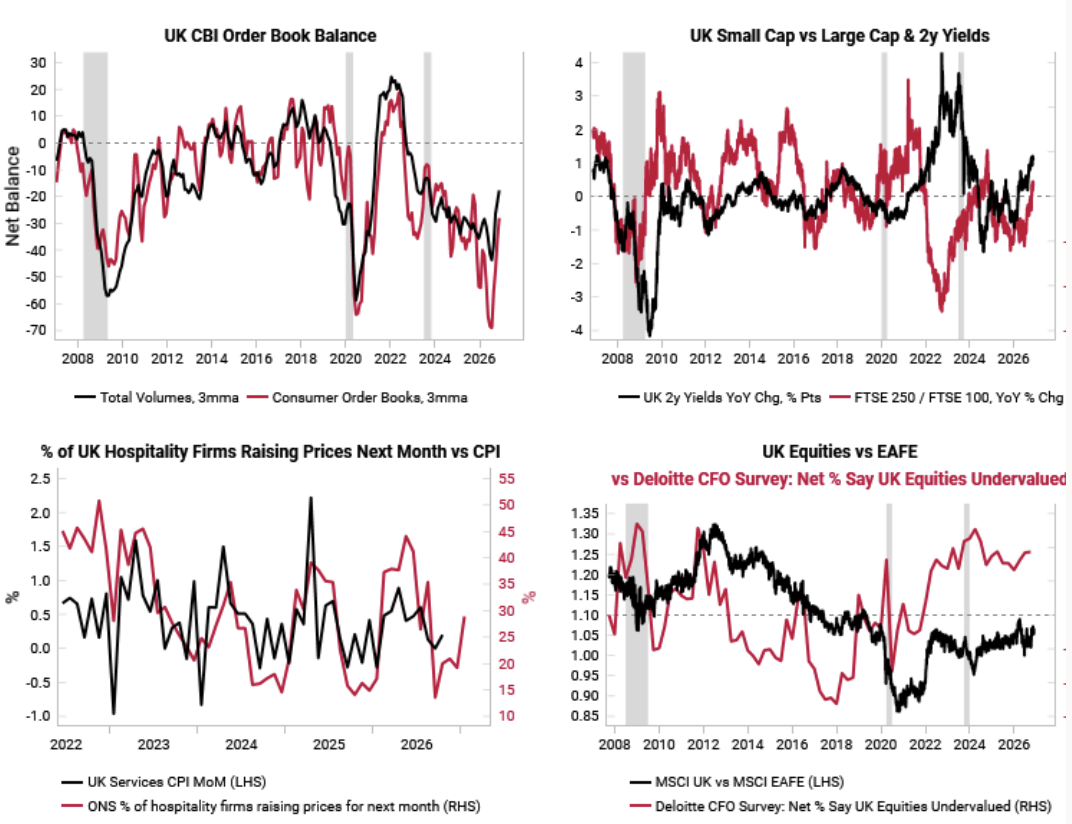
Variant Perception takes profit on its SONIA flattener and urges asset allocators to start looking towards UK equities as growth and inflation leading data bounce.
Variant Perception takes profit on its SONIA flattener and urges asset allocators to start looking towards UK equities as growth and inflation leading data bounce. UK CBI order books continue to rise alongside outperformance of UK small-cap equities over large caps, signalling expectations for better growth that are corroborated by its UK growth leading indicator. Simultaneously, its UK inflation leading indicator is rising again and services price intentions have picked up, while the ONS hospitality survey shows a jump in firms intending to raise prices, making it harder for the Bank of England to pivot dovish as growth stabilises. Given the improving nominal growth outlook, UK equities look poised to outperform as a low-AI alternative within developed markets. UK equities already screen well as capital-scarce and less crowded, trade at reasonable valuations, and UK CFOs view UK equities as undervalued, a structural indicator of future outperformance.
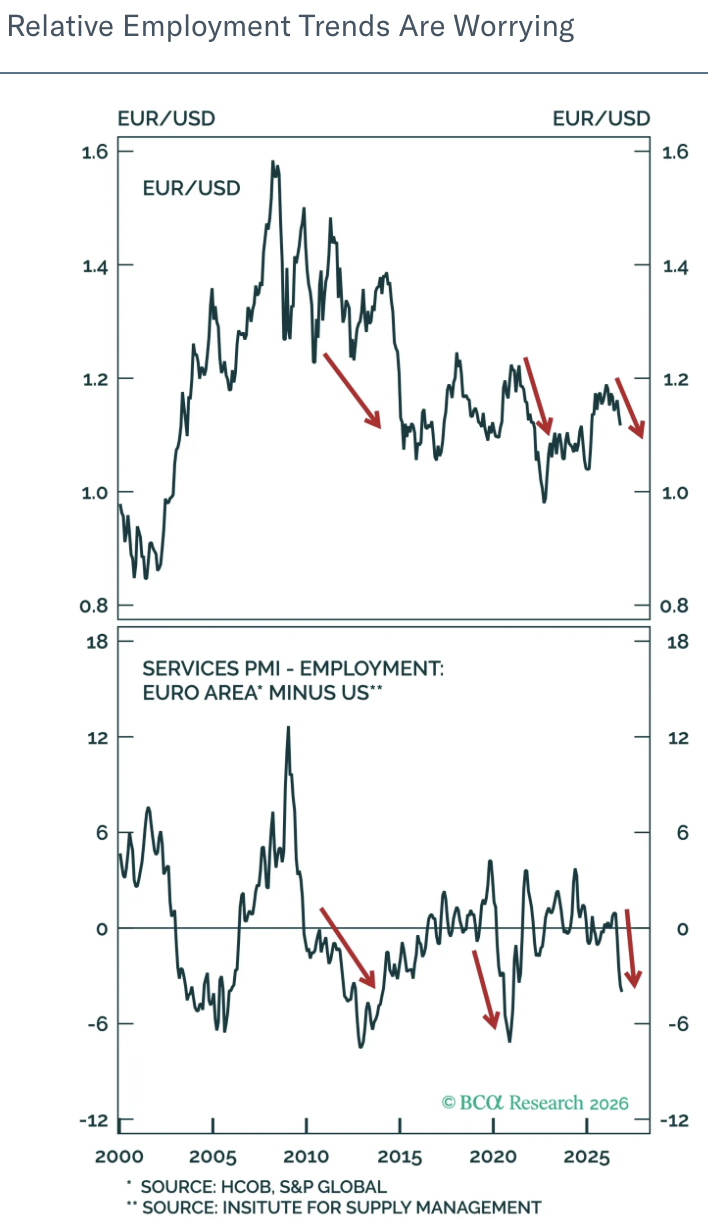
Year-end dollar seasonality, extreme oversold conditions, positive economic surprises, a less hawkish Fed and a pause in the French crisis set the stage for a brief EUR/USD bounce toward 1.12.
Year-end dollar seasonality, extreme oversold conditions, positive economic surprises, a less hawkish Fed and a pause in the French crisis set the stage for a brief EUR/USD bounce toward 1.12. However, BCA expects this tactical rebound to be short-lived as a long-term dollar bear market takes a breather and an outright greenback rebound continues. Weak European growth in the first half of 2027, driven by the Global Growth Tax, Chinese competition, softening domestic demand and tight financial conditions, will keep the ECB lagging other central banks and entrench the euro's low-carry status. Ahead of France's spring 2027 presidential election, rising policy uncertainty and a potential Le Pen and Mélenchon second-round contest will revive fiscal and political risk premia, pushing OAT yields higher and dragging EUR/USD to around 1.05. Very short-term traders can play the bounce with a tight stop loss at 1.0850, while nine-to-twelve-month investors should sell into strength.
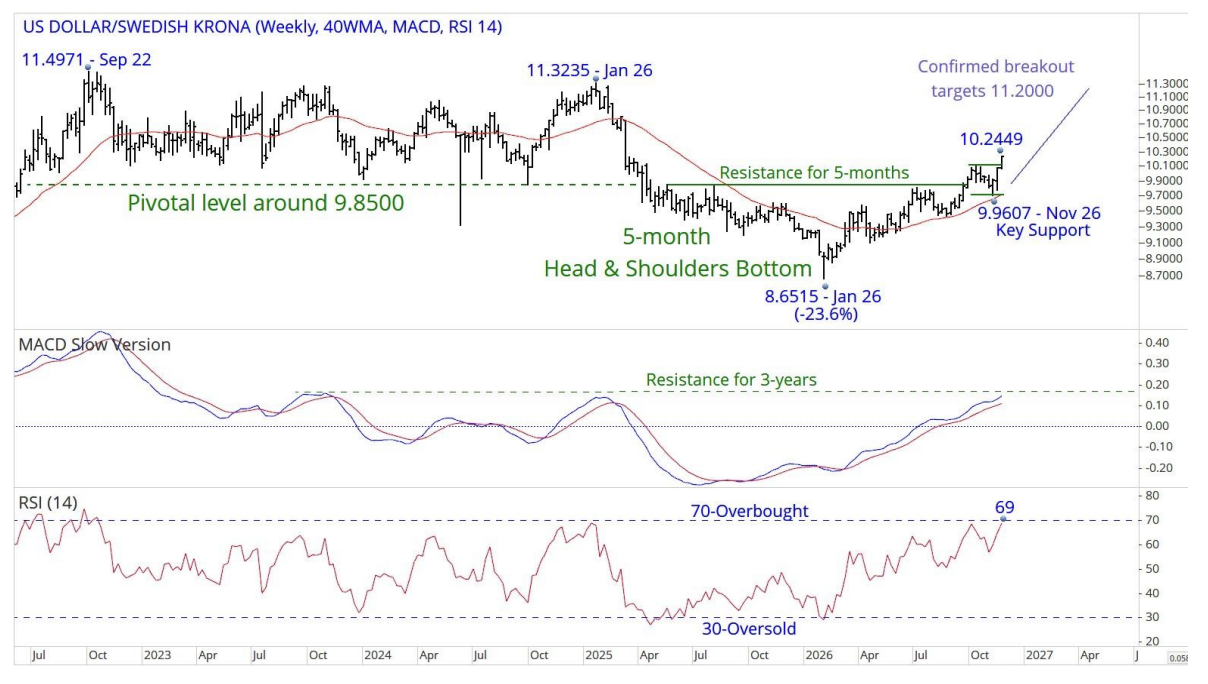
USD/Swedish Krona (SEK10.2283). The USD has broken above the Pivotal SEK9.8500 level. At the same time the USD has completed a 5-month Head & Shoulders bottom, targeting an advance to SEK11.2000, just below Major Resistance at SEK11.3000-11.5000. The weekly MACD is around resistance that has been a barrier for 3-years and 14-week RSI is close to the Overbought Zone that starts at 70. Chris Roberts would consider adding into a modest consolidation. Given the position of the indicators, Chris would view some weakness as a technical correction. Chris is 50% long the USD from SEK9.9518, the stop moves up to a daily close below SEK9.8611.
Carl Weinberg consumer confidence surged in November by 11.4 points after a big 7.5-point jump in October.
Carl Weinberg consumer confidence surged in November by 11.4 points after a big 7.5-point jump in October. Market participants and economists expected some improvement in confidence after elections, but this result is off the hook! At 103.3 for November, this confidence index is higher than it has been since Inauguration Day. It is above its 60-year average of 96 by a wide margin after being below that average since August 2025. The bounceback is evident in all components. Jobs apparently are becoming more plentiful on trend over the last month. Markets see that as good news, too. It is also a sign of a tight labour market at full employment. Carl says the Fed will notice all of this, but this is only one of many expectation indicators the FOMC monitors. Confidence is a factor in determining consumer spending, but it is not the dominant factor. Rattled consumers spend less than confident consumers, sure, but income fluctuations matter more to the course of current spending by far.
Developed Markets
US service sector disinflationary signals proliferate
Danielle DiMartino Booth points out that Michigan upper-income expectations for their current finances slumped into negativity in early November, while the cohort's views of the labour market and its auto-buying
Danielle DiMartino Booth points out that Michigan upper-income expectations for their current finances slumped into negativity in early November, while the cohort's views of the labour market and its auto-buying conditions deteriorated to the worst reading in a year and a four-year low, respectively. Although households still harbour greater concerns about inflation than they do about the jobs market, cooling in the Kansas City Fed's services sector across input and output prices, as well as wages, echoed other regional Fed service sector slowdowns. Danielle warns that if only Fed officials could be anticipatory rather than reactive, they would not be headed for a policy error. Given there were eight rallies that crossed the 15% mark in the 2000-2002 Nasdaq before it bottomed, the call is to trade the rallies for all they are worth with a full appreciation of the ultimate destination.
Japan ownership among active global funds continues to rise in absolute terms, with 87.7% of funds holding exposure, yet average weights remain pinned near the lower end of their 15-year range and Japan persists as a structural underweight.
Japan ownership among active global funds continues to rise in absolute terms, with 87.7% of funds holding exposure, yet average weights remain pinned near the lower end of their 15-year range and Japan persists as a structural underweight. Despite despite attracting USD$3.5bn in net inflows over the past six months, 75% of funds still run allocations below their long-term median, while the relative underweight versus the SPDR ACWI ETF has widened. Value strategies are the lead allocators, maintaining average weights more than twice those of Aggressive Growth funds, which sit near record lows. Sector positioning concentrates in Information Technology and Industrials, while stock-level ownership remains dispersed beyond Keyence Corp and Sony Group, with 228 Japanese stocks held by just 1% to 10% of global funds. Even as Japanese equities break above multi-decade highs, active investors are re-engaging with discipline, not exuberance.
Capital city house prices have fallen by 11% from peak in real terms, with real drops exceeding 20% in Melbourne and Sydney and 10% in Brisbane and Perth.
Capital city house prices have fallen by 11% from peak in real terms, with real drops exceeding 20% in Melbourne and Sydney and 10% in Brisbane and Perth. Higher rates cut borrowing capacity, while scrapped investor tax breaks further curb housing finance approvals and loan growth. Gerard Minack argues that population growth drives house prices more than supply, warning that slower migration could leave prices permanently lower relative to income. Even so, weaker prices pose limited near-term drag on growth because the wealth effect has weakened since the GFC, leaving household saving around its post-GFC average. With full bank recourse over mortgages and stable employment, Gerard expects further orderly declines rather than widespread mortgage stress. Yet he flags a 25% risk over 12 months that job losses could spark forced selling and turn an orderly decline into a disruptive housing rout, though that is not his base case.
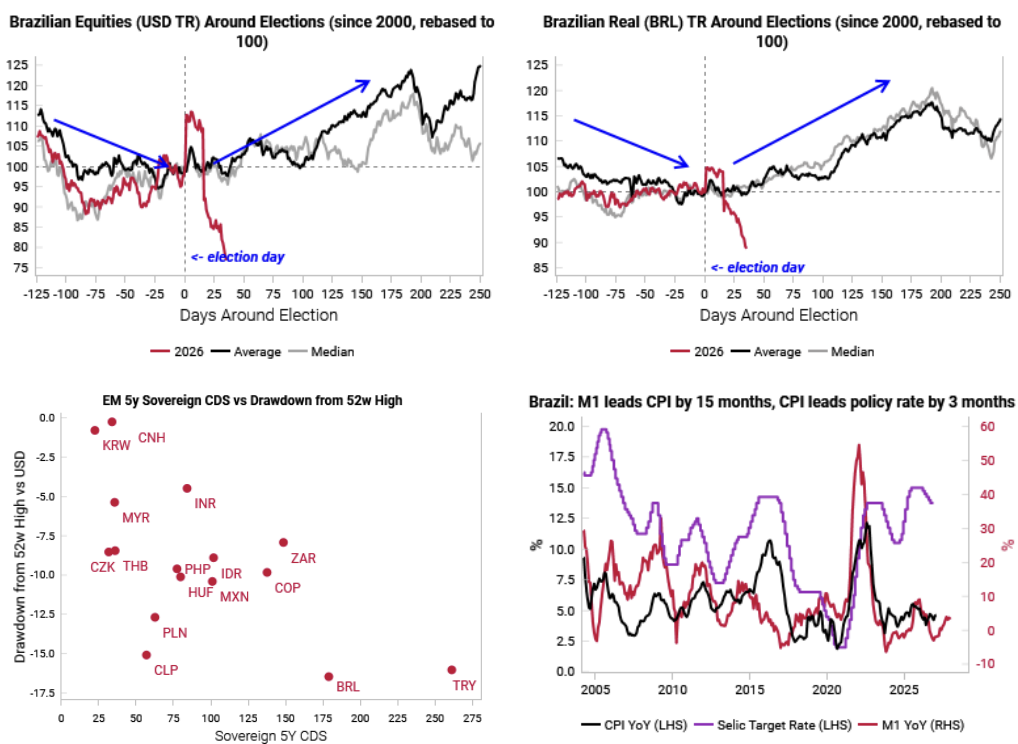
Lula’s presidential win by 51.8% to 48.2% has triggered one of the sharpest election-related sell-offs in sample, with Brazilian equities and the real tracking far below typical election paths.
Lula’s presidential win by 51.8% to 48.2% has triggered one of the sharpest election-related sell-offs in sample, with Brazilian equities and the real tracking far below typical election paths. Yet centre-right majorities in both chambers of Congress, led by PL as the largest party, remove the tail risk of a truly populist lurch. History shows risk premia unwind once a fiscal anchor appears: in 2002 to 2003, an orthodox finance team and higher primary surplus target took the real from about 3.95 to 2.9 within a year, while in 2023 a new fiscal rule passed a conservative Congress, the central bank cut from 13.75%, today's Selic, and the Ibovespa rose 22%. Today, the real has collapsed and underperformed given where sovereign CDS trades. Real rates near 9% offer a large cushion, subdued M1 growth points to no inflation surge, and outright value does not depend on AI capex. Stay long Brazilian equities.
GDP data for the third quarter were broadly unfavourable and surprised to the downside: GDP contracted 1.1%, its weakest reading since 4Q22.
GDP data for the third quarter were broadly unfavourable and surprised to the downside: GDP contracted 1.1%, its weakest reading since 4Q22. Nevertheless, Igal Magendzo expects an economic recovery next year. His baseline scenario projects GDP growth of 3.0%, closer to the 3.4% global growth forecast by the International Monetary Fund. Rather than an optimistic scenario, this primarily reflects his expectation that the multiple shocks affecting consumption and production will reverse. Also, investment should resume an expansionary path, supported by large mining and energy projects and deregulation. Monthly data for August and September have provided early signs of such a recovery. Meanwhile YoY headline CPI inflation increased significantly in October, from 4.1% to 4.5%, primarily reflecting the global fuel price shock and, to a lesser extent, the effects of El Niño. Although Igal expects YoY headline inflation to increase further over the coming months, this does not imply stronger underlying inflationary pressures.
Horizon Insights stays long China equities over a 6–12 month horizon despite a rough past month because sector valuation dispersion across 31 main sectors sits near trough extremes seen in Oct 2008, Dec 2012, Oct 2018
Horizon Insights stays long China equities over a 6–12 month horizon despite a rough past month because sector valuation dispersion across 31 main sectors sits near trough extremes seen in Oct 2008, Dec 2012, Oct 2018 and Jul–Aug 2024, where being long beat staying flat. In A-shares, market timing drives major rallies more than stock selection, while 4–6 month turnover cycles with daily turnover near RMB 1.5tn mark lows. China's growth engine has shifted as property fell from RMB 17tn to about RMB 7tn while exports climbed from RMB 17tn to about RMB 30tn on own brands and general trade, pointing to 5–10% export growth next year. Horizon Insights targets global winners across consumer, healthcare and industrials, holding roughly 30 China Quality names near 20% earnings growth and 10x forward P/E alongside going-global exposure, with crude at USD$80 while Hormuz stays closed and below USD$60 if reopened ahead of December Fed and November CPI catalysts.
Despite two hold votes suggesting a dovish hike, the Bank of Korea lifted its median dot plot to 3.5%, with dots at 3.75% outnumbering those at 3.25% by one, signalling this is not the end of rate hiking.
Despite two hold votes suggesting a dovish hike, the Bank of Korea lifted its median dot plot to 3.5%, with dots at 3.75% outnumbering those at 3.25% by one, signalling this is not the end of rate hiking. The bank raised 2026 and 2027 growth forecasts, expecting 4.1% next year and 3% in 2028 alongside upgraded current account projections, while domestic demand growth stays relatively modest around 3%. Paul Cavey explains that senior officials ground their faith in semiconductor order volumes and rising national income spilling over into real GDP and GDI, even though it takes time. Governor Shin also noted cost pass-through and demand support inflation, while potential growth estimates have limits. Paul argues that stronger nominal GDP creates conditions for rates to go higher, but markets will only price that if investors share more confidence in the AI cycle than equities have shown in recent weeks.
South Africa’s local election results on November 4 pose the greatest threat yet to the country’s centre-right coalition, after the ruling African National Congress won just 30.9% of the national vote, its worst showing
South Africa’s local election results on November 4 pose the greatest threat yet to the country’s centre-right coalition, after the ruling African National Congress won just 30.9% of the national vote, its worst showing in a democratic election. Blaming its Democratic Alliance partners for the decline, the ANC’s National Executive Committee resolved to form local coalitions with the DA only as a last resort. Niall Ferguson expects the national coalition to collapse within six months, ushering in a new government with the MKP, EFF, and South African Communist Party if the ANC leaves the DA and Freedom Front Plus out. Such a shift risks President Cyril Ramaphosa's resignation and mirrors Jacob Zuma's 2009-17 presidency, when gross debt-to-GDP climbed from 27% to 49% alongside rampant corruption. Markets are increasingly worried, and Niall suspects the recent sell-off in the rand has further to go as South African assets suffer.
Venezuela's government programme, Venezuela Renace, published by the Ministry of Economy and Finance, pegs public debt at USD$237.5bn, yet offers little comfort to bondholders seeking a swift workout as any debt exchange
Venezuela's government programme, Venezuela Renace, published by the Ministry of Economy and Finance, pegs public debt at USD$237.5bn, yet offers little comfort to bondholders seeking a swift workout as any debt exchange sits across phases one to two over up to three years. Excluding intra-public sector debt, including the Republic 2036 bond, external debt drops to roughly USD$195bn, while international bonds total USD$110.1bn including USD$45.9bn in past-due interest. Jose Ignacio Hernandez argues that celerity signals a smooth, incremental process rather than an abbreviated workout, with preparatory reconciliation and a credible debt sustainability analysis likely taking 12 months. Jose Ignacio expects Washington to issue an OFAC license for creditor talks, deeper IMF involvement ahead of a December visit, and opposition pushback ahead of a possible late-2027 presidential vote demanding a newly elected government handle restructuring. Early settlements of strategic claims and multilateral normalisation with the IDB and CAF remain plausible alongside gradual reconciliation.
Bitcoin: Potential December weakness seen as an opportunity
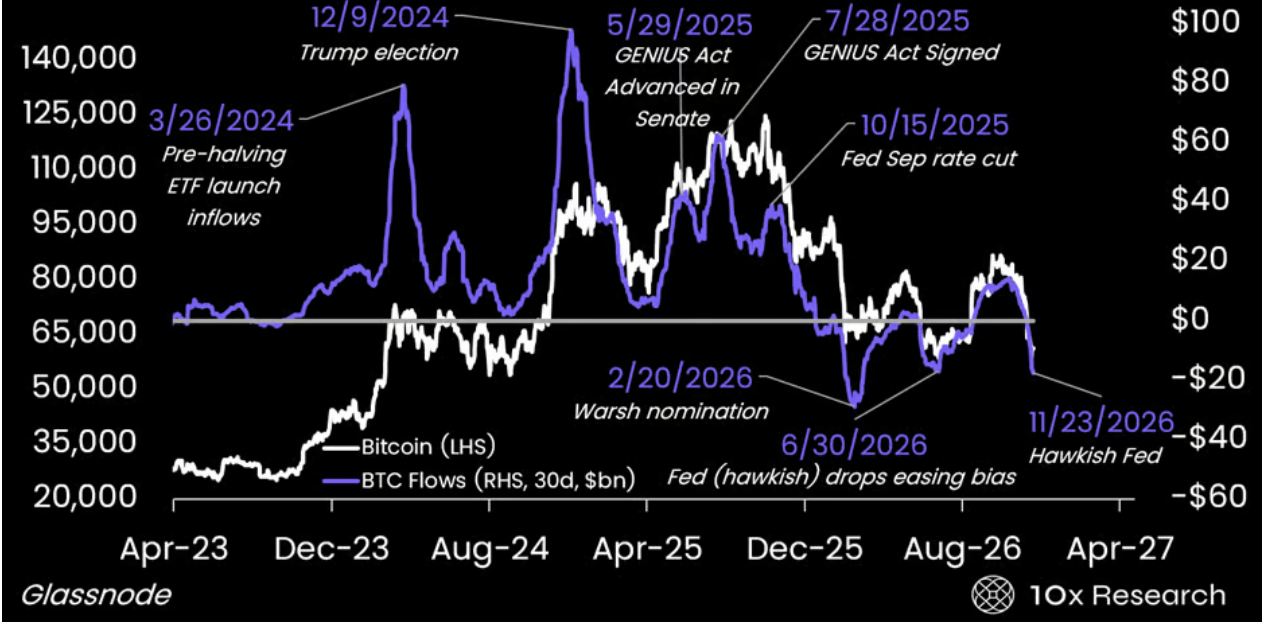
According to Markus Thielen, Bitcoin is still trading as a liquidity asset, and the drop in Realized Cap to about −$17 billion reflects recent buyers selling at a loss as the Fed turned more hawkish, not a lack of crypto-specific catalysts.
According to Markus Thielen, Bitcoin is still trading as a liquidity asset, and the drop in Realized Cap to about −$17 billion reflects recent buyers selling at a loss as the Fed turned more hawkish, not a lack of crypto-specific catalysts. That November low came with smaller outflows than February's, suggesting much of the capitulation has already happened. Year-end tax selling is the last obvious source of supply. Markus estimates $2 to $4 billion of net ETF outflows, concentrated between December 14 and December 31, although much of it will be investors switching between funds rather than exiting. Once that selling clears, the wash-sale calendar brings buyers back from mid-January, just as the inflation and policy backdrop should begin to turn supportive (from March at the latest, but watch oil prices fall below $80). Markus would treat further weakness into late December as an opportunity, and would look for monthly Realized Cap outflows to narrow as confirmation that the selling has run its course.
James Burdass says that the sell-off creates an opportunity for materials portfolio managers to do more than buy existing holdings at lower prices.
James Burdass says that the sell-off creates an opportunity for materials portfolio managers to do more than buy existing holdings at lower prices. It offers a chance to upgrade portfolio quality: reallocating capital towards businesses with stronger assets, lower costs, better balance sheets and the capacity to generate cash through the cycle. That means distinguishing between established producers whose operating and financial strength has been obscured by indiscriminate selling, and growth companies whose valuations have fallen sharply but whose investment cases still depend on execution. Both can offer opportunity, but they are not the same risk. James notes that AI features increasingly prominently in the longer-term copper demand narrative, but its direct contribution should not be overstated. He says the investment case for copper remains much broader, encompassing electrification, grid expansion, industrial demand and supply constraints.
In this presentation, Jeffrey Christian of CPM Group discusses the gold price outlook, silver’s test of $40, and what investor selling reveals about the precious metals market.
In this presentation, Jeffrey Christian of CPM Group discusses the gold price outlook, silver’s test of $40, and what investor selling reveals about the precious metals market. Gold bounced near $3,500, a technical level many investors were watching, but CPM Group remains cautious about calling a bottom after support between $3,800 and $4,000 gave way. Silver has shown greater weakness, breaking below $50 and trading near $40. Jeff explains how investors can sell large amounts of silver while remaining net buyers overall. In 1997, Berkshire Hathaway bought nearly 130 million ounces, yet CPM estimates that investors as a group were net sellers of about 160 million ounces. He also explains how CPM measures the balance between newly refined silver supply and fabrication demand, and why it tracks investment demand separately. The presentation also looks at where silver is held, from official bullion coins to ETFs and exchange inventories, and how reported inventories can appear steady even as metal moves from refiners to fabricators.
Click here to watch.
Navigate Commodities uses thermal and optical satellite imagery alongside vessel-tracking data to provide investors with info on iron ore, ferrous scrap, and steel markets.
Navigate Commodities uses thermal and optical satellite imagery alongside vessel-tracking data to provide investors with info on iron ore, ferrous scrap, and steel markets. Following a production shutdown at Habaş, national EAF capacity utilisation across Turkiye bottomed around 38% on 18-19 November 2026 before rebounding 17 percentage points to 55% by 23 November, reflecting increased thermal activity across competing steelworks. Cebitaş Demir Çelik, İçdaş,İzmir Demir Çelik, Kardemir, Koç Metalurji, and Yeşilyurt led with double-digit week-on-week EAF capacity utilisation hikes, several advancing approximately 20-30% or more, while Kroman, Özkan Demir Çelik, Tosçelik Osmaniye, and Yazıcı Demir Çelik gained roughly 5-10%. Higher EAF capacity utilisation could gradually moderate domestic rebar price inflation and implies greater ferrous scrap consumption, providing modestly supportive scrap fundamentals alongside operating mills, though actual production recovery and additional scrap procurement require further confirmation amid potential Habaş resales of distressed cargoes.